England’s most exhausted regions, mapped.
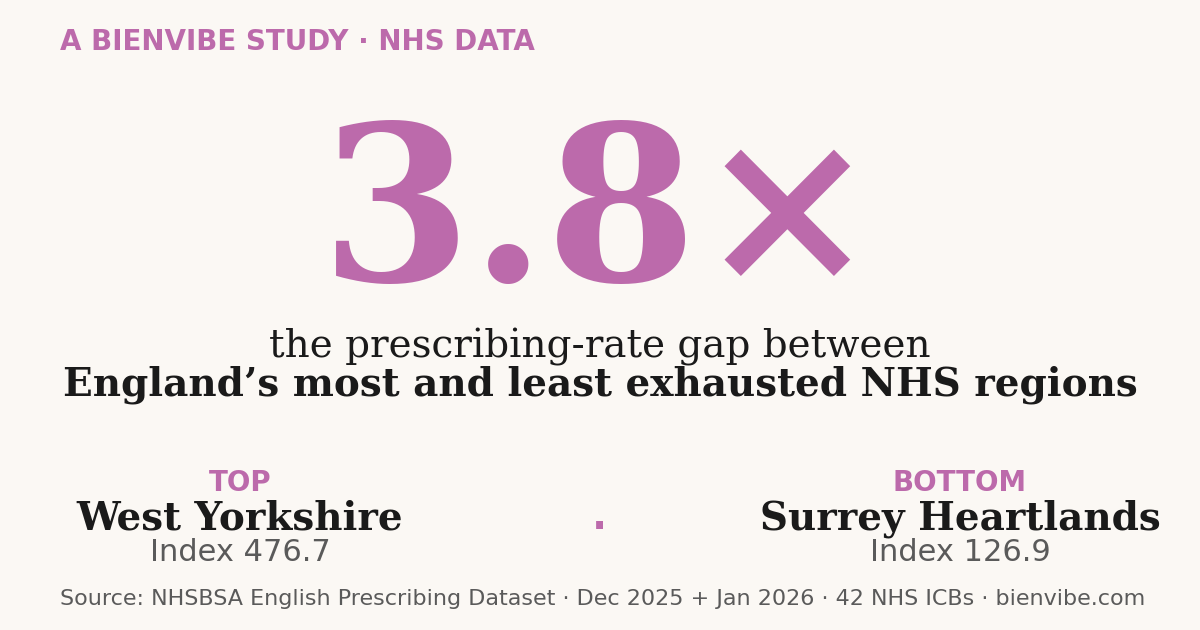
We analysed every antidepressant, anti-anxiety and sleeping-pill prescription dispensed in England across two months — 27.9 million prescription items in total. One region prescribes nearly four times the rate of the lowest. The result is a prescribing-based proxy for where stress, sleep and mental-health pressure are landing hardest — England’s burnout map.
A country that can’t sleep
Britain is tired. The NHS Business Services Authority recorded 8.89 million people in England prescribed antidepressants in 2024/25 — about one in six adults. Sleeping-pill prescribing is at a decade-high, and anti-anxiety drug dispensing has climbed every year since 2019. But national averages hide a more uncomfortable truth: prescribing pressure — a proxy for where population-level stress, sleep and mental-health strain are landing — is not evenly distributed.
Bienvibe set out to map it. Using open data published by the NHS Business Services Authority — the same ledger the NHS uses to pay pharmacies — we extracted every community prescription dispensed in England across December 2025 and January 2026, filtered for three drug families most closely associated with stress, sleep and mental health, and normalised the totals against each region’s registered patient population. The headline number: 27.9 million prescription items dispensed in two months — about 14 million a month. 89% of them were antidepressants.
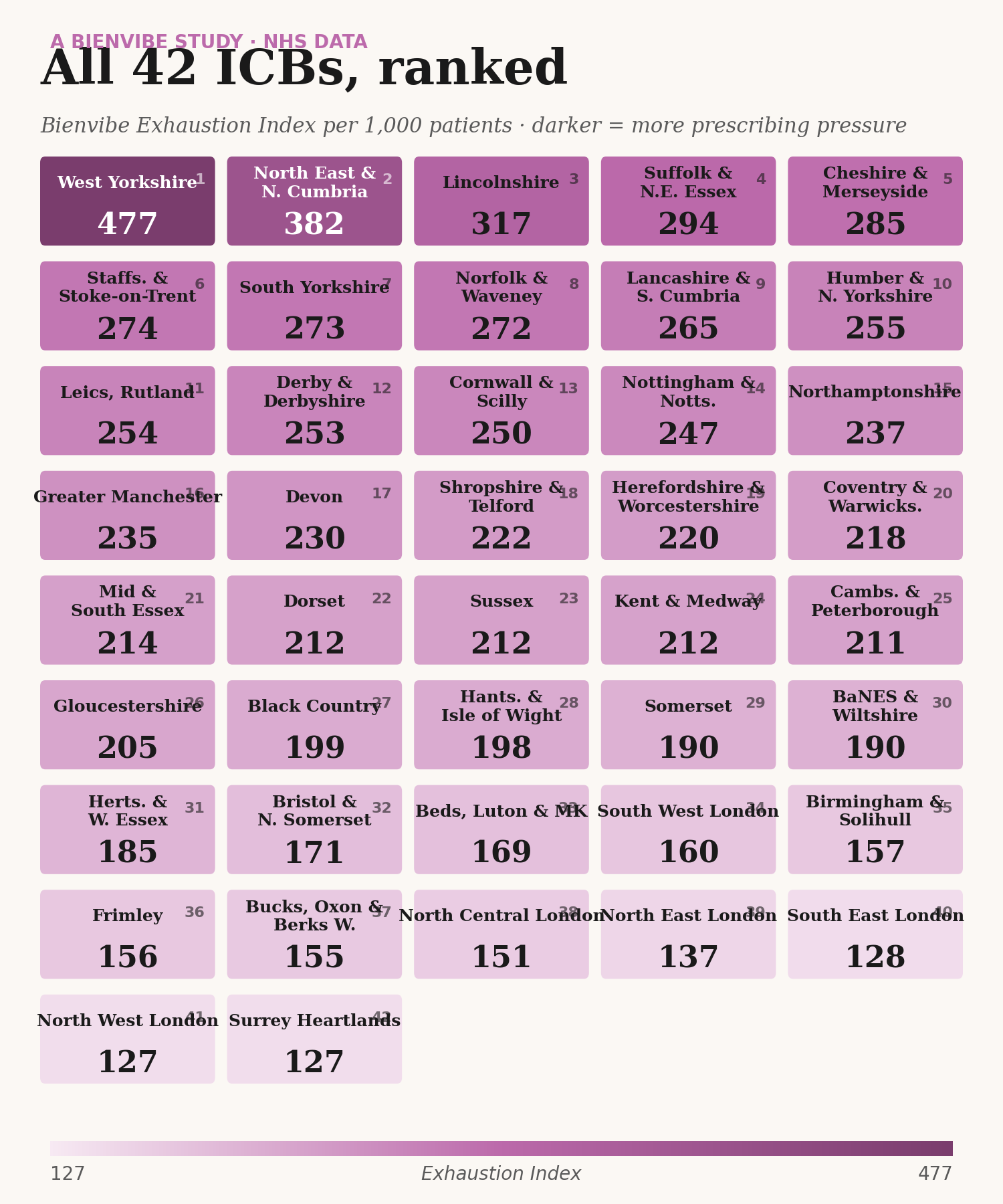
The result is the Bienvibe Exhaustion Index: a single number, per 1,000 people, for each of the 42 NHS Integrated Care Boards that cover England. Higher = more exhausted.
The ranking
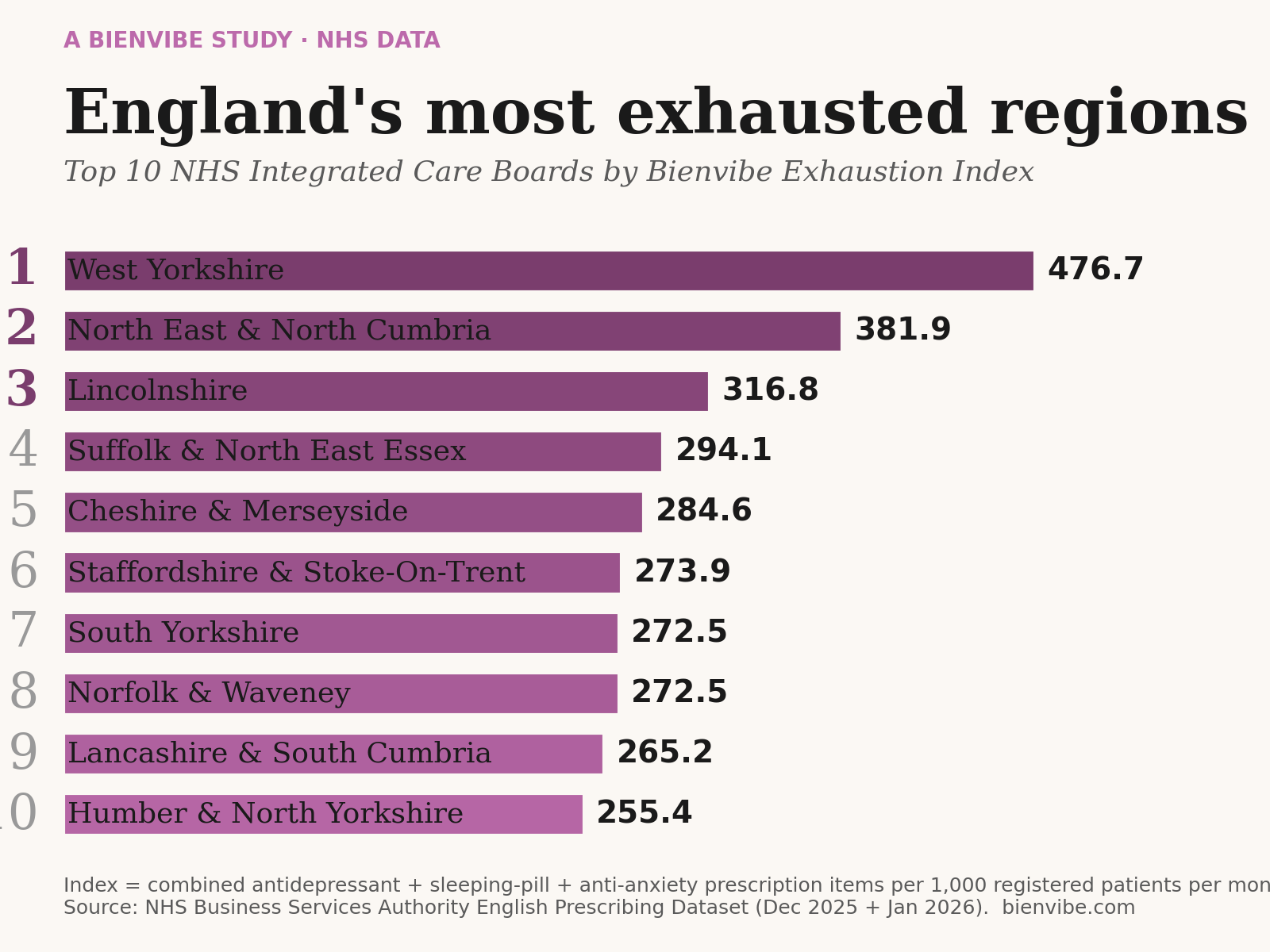
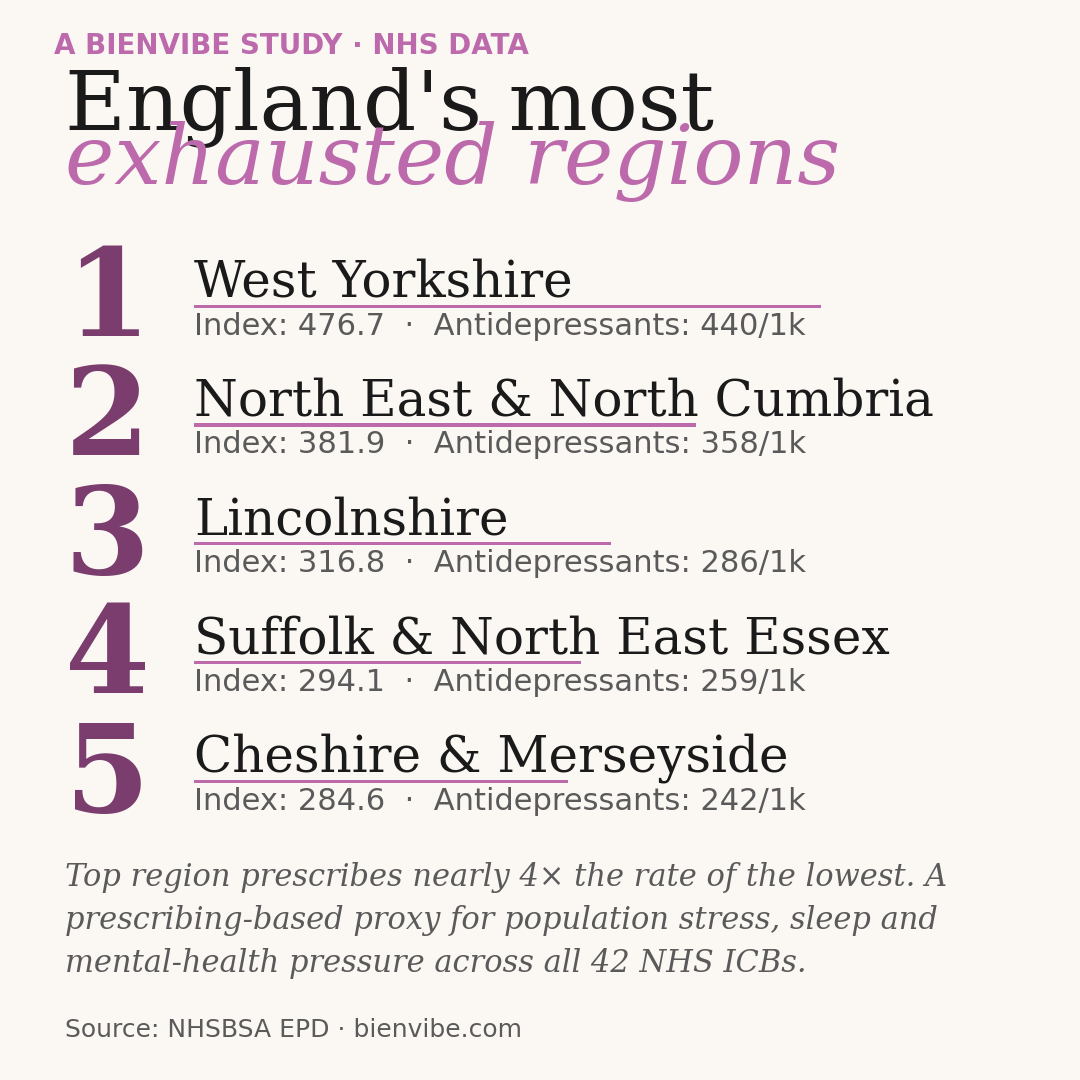
The ten regions below receive the most stress, sleep and anxiety prescriptions per head in the country. Bar width is proportional to the Exhaustion Index value; the top of the country prescribes nearly four times the rate of the lowest of all 42 ICBs.
| # | NHS Region | Index |
|---|---|---|
| 1 | West Yorkshire Leeds, Bradford, Huddersfield | 476.7 |
| 2 | North East & North Cumbria Newcastle, Sunderland, Carlisle | 381.9 |
| 3 | Lincolnshire Lincoln, Boston, Grimsby | 316.8 |
| 4 | Suffolk & North East Essex Ipswich, Colchester | 294.2 |
| 5 | Cheshire & Merseyside Liverpool, Chester, Warrington | 284.6 |
| 6 | Staffordshire & Stoke-on-Trent | 273.9 |
| 7 | South Yorkshire Sheffield, Rotherham, Doncaster, Barnsley | 272.5 |
| 8 | Norfolk & Waveney Norwich, Great Yarmouth | 272.5 |
| 9 | Lancashire & South Cumbria Preston, Blackpool, Lancaster | 265.2 |
| 10 | Humber & North Yorkshire Hull, York, Scarborough | 255.4 |
All figures are monthly averages, prescription items per 1,000 registered patients. Full 42-region ranking available on request.
What the map tells us
Three patterns jump out of the data, and none of them is new to public-health researchers — they are the same patterns the Institute for Public Policy Research has been flagging for a decade. What is new is how clearly they show up in a single two-month window of NHS dispensing.
A clear North–South axis. Of the ten most-prescribed regions, seven are in the North of England. The pattern survives any cut of the data — antidepressants alone, sleeping pills alone, anti-anxiety alone.
Coastal communities punch above their weight. Norfolk & Waveney, Humber & North Yorkshire and Lincolnshire all rank disproportionately high, echoing the “left-behind coastal towns” findings of the Chief Medical Officer’s 2021 report. Norfolk & Waveney tops the country for anti-anxiety prescribing at 18.2 per 1,000.
London is the outlier. Despite its reputation as a pressure-cooker, four of the five lowest-prescribing ICBs in England are London — including North West London, South East London and North East London. This is not evidence Londoners are calmer — researchers have long argued that access to private therapy, younger demographics, and GP-capacity issues all suppress NHS prescription rates in the capital.
Sleeping pills cluster on Merseyside. Cheshire & Merseyside (which includes Liverpool) tops the country for sleeping-pill prescribing specifically, at 25.1 items per 1,000 — more than three times the London rate.
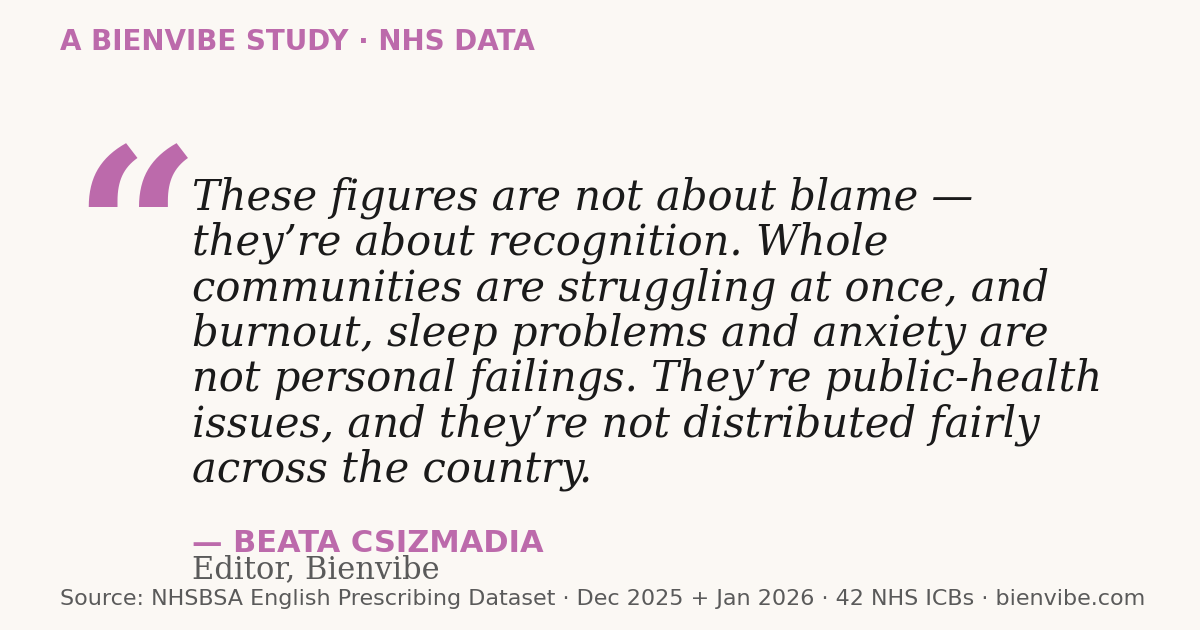
“These figures are not about blame — they’re about recognition. Behind every one of these prescriptions is a real person trying to cope with something heavy. What the data tells us is that whole communities are struggling at once, and we need to stop treating burnout, sleep problems and anxiety as personal failings. They’re public-health issues, and they’re not distributed fairly across the country. The fact that someone in Leeds is nearly four times as likely to be on an antidepressant, sleeping pill or anti-anxiety drug as someone in Guildford isn’t about willpower — it’s about where the pressure lands in modern Britain.”
— Beata Csizmadia, Editor, Bienvibe
Methodology
The Bienvibe Exhaustion Index is built on open, authoritative NHS data. Everything in this report can be reproduced from scratch using the sources below.
Full methodology
We analysed two months of NHS Business Services Authority English Prescribing Dataset (December 2025 and January 2026), covering every community prescription dispensed in England. Three drug categories were isolated: antidepressants (BNF chapter 04.03), hypnotics and sedatives including sleeping pills (BNF 04.01.01), and anxiolytics / anti-anxiety drugs (BNF 04.01.02). Combined total across the two months: 24.8 million antidepressant items, 1.8 million sleeping-pill items and 1.4 million anti-anxiety items.
For each of the 42 NHS Integrated Care Boards (ICBs) — the structure in force before the 1 April 2026 ICB merger and boundary changes — we summed prescription items dispensed per month, then divided by the ICB’s registered patient population (NHS Digital, 2025 release) to produce a per-1,000-patients monthly rate. The composite Exhaustion Index is the sum of the three per-capita rates.
Caveats. The Exhaustion Index is a prescribing-based proxy for population-level stress, sleep and mental-health pressure — not a direct measure of how tired individual people feel. Prescribing rates reflect GP decisions, patient help-seeking behaviour and local prescribing norms; they are influenced by access to private therapy, GP capacity and local demographics. Over-the-counter remedies, private prescriptions and untreated cases are not captured. The 8.89 million-person figure cited in the introduction is the NHSBSA’s annual unique-patient count for antidepressants in 2024/25 and is provided for context only — it is not part of the index calculation.
Source. NHS Business Services Authority (NHSBSA Copyright 2026), released under the Open Government Licence v3.0. Population figures: NHS Digital.
For journalists & editors
The full dataset, methodology document, high-resolution graphics and interview availability are all free to use for editorial purposes. Please credit Bienvibe — bienvibe.com and link to this page.
Shareable graphics
Press-ready PNGs in Bienvibe brand colours. Click to download, then drop straight into your article, social post or media kit. Each is sized for its platform.