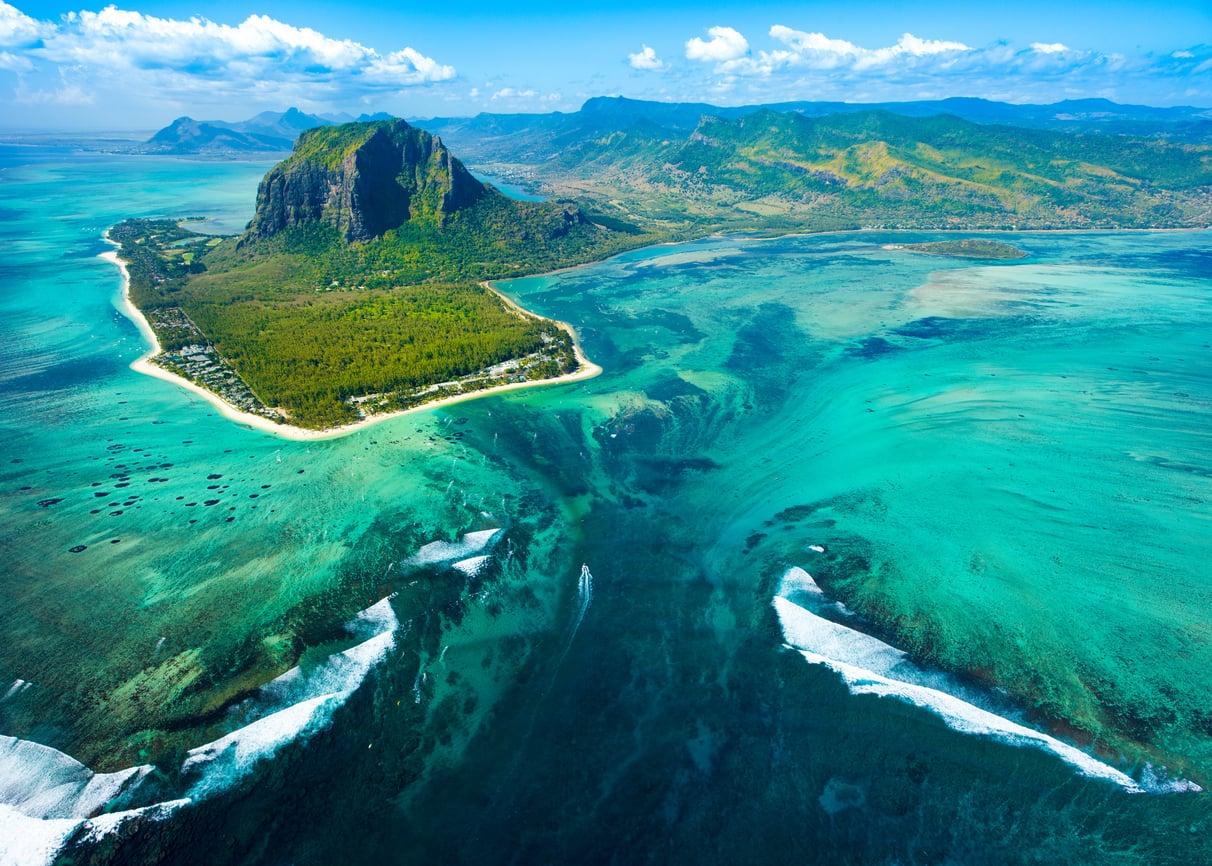
Off the southwestern tip of Mauritius, the Indian Ocean does something that seems physically impossible: it looks like it's pouring off the edge of the world. From above, a vast curtain of water appears to cascade into an endless underwater abyss — a sight so convincing it has puzzled tourists, photographers, and even satellite operators. And yet, nothing is actually falling at all.
How the illusion is created
The secret lies beneath the surface. Around the shores of Mauritius, powerful ocean currents constantly shift sand and silt deposits along the seabed. As these sediments are swept in a particular direction, they create dramatic gradients of color and depth in the water above — light turquoise bleeding into deep indigo, as if the ocean floor is suddenly giving way.
When sunlight hits the water at just the right angle, the effect becomes even more striking. The water turns crystal clear, and the swirling sediment below creates the unmistakable impression of a massive waterfall plunging into the depths. It's a natural trompe l'oeil — the ocean and sky conspiring to trick the eye.
The illusion is best seen from high altitude: from a plane, a helicopter, or via satellite imagery. At ground level, you'd never know it was there.
Even satellites do a double take
What makes this phenomenon especially remarkable is that it doesn't just fool the human eye — it shows up just as dramatically in satellite images. The contrast of colors and the sweeping shapes formed by the sand plumes create a visual signature so unusual that satellite operators have documented it as one of nature's most striking optical tricks.
Year after year, aerial images of this corner of Mauritius circulate online and leave viewers genuinely confused. Is it real? Is it dangerous? Could you actually swim near it? The questions keep coming — which is part of what makes this place so magnetic.
Why this illusion matters
There's something deeply humbling about the fact that ordinary sand deposits can produce a spectacle this extraordinary. No volcanic eruption, no tidal wave — just sediment drifting in a current, and suddenly the ocean looks like it has a drain.
For scientists and nature lovers, it's a reminder of how much the Earth can still surprise us. For photographers and filmmakers, it's an irresistible subject — a ready-made visual wonder that needs no filter and no editing. Mauritius becomes something more than a paradise island in these images; it becomes a place where geography itself seems to bend the rules.
How to see it for yourself
Thousands of travelers visit Mauritius every year drawn by its white-sand beaches, turquoise lagoons, and lush tropical scenery. But those who know about the underwater waterfall make a point of booking a helicopter tour or scenic flight to experience it from above — and for good reason.
Many local tour operators offer aerial excursions specifically designed to fly over the southwestern tip of the island, where the illusion is most vivid. Seeing it in person, from the air, is one of those rare travel moments that genuinely takes your breath away.
If you're planning a trip to the Indian Ocean region, this is the kind of sight worth building an itinerary around. It costs nothing extra to look out the window — but what you see might stay with you for a lifetime.
A world still full of surprises
The underwater waterfall of Mauritius is more than a visual curiosity. It's a beautiful reminder that our planet is still full of mysteries — some hidden in the deep ocean, others hiding in plain sight, waiting to be noticed from the right angle.
In an age when satellite maps have charted nearly every corner of the Earth, it's quietly thrilling to know that nature can still produce something that makes us stop, stare, and ask: how is that even possible?