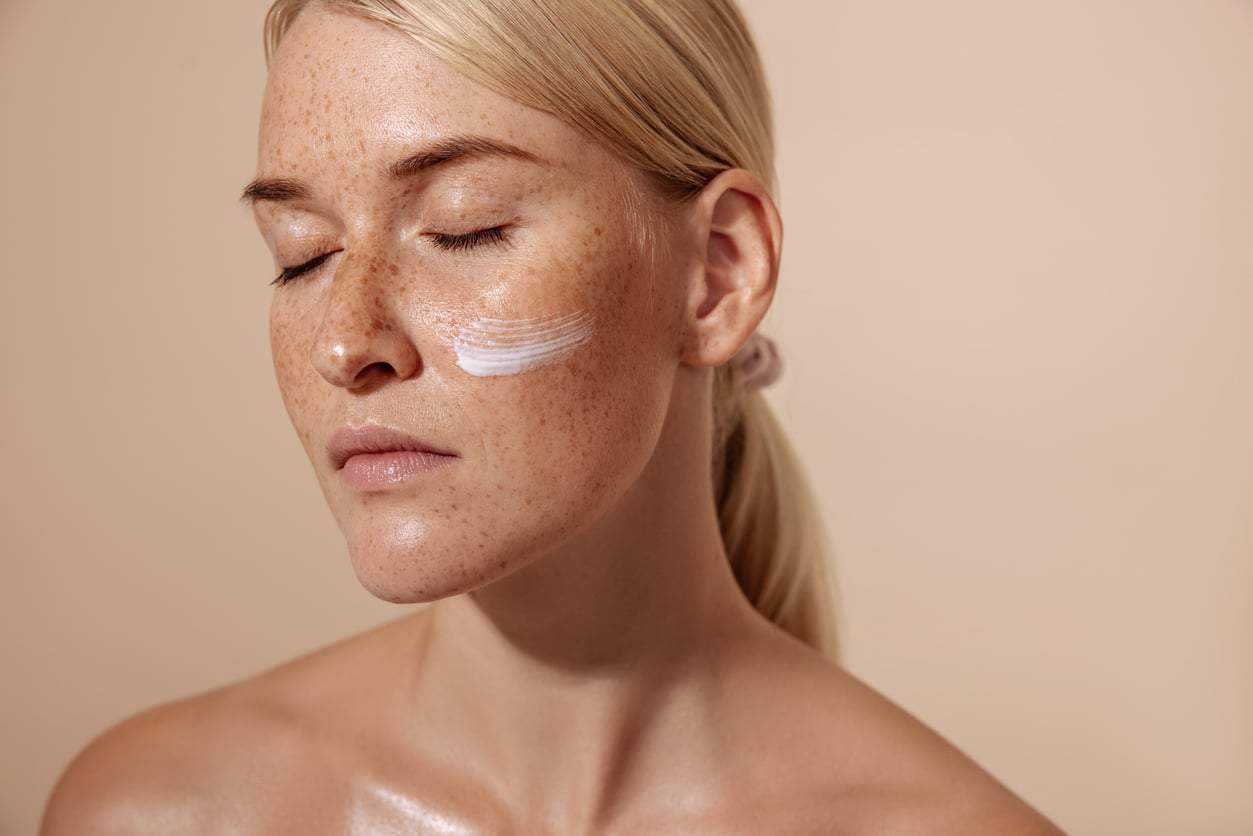
I watched someone in a beauty aisle recently put a moisturiser back on the shelf, pick up her phone, scan the barcode, read a colour-coded score, and walk away empty-handed. She had come in for a face cream. She left with a low-grade sense of having narrowly avoided something. This is where a lot of us are now: fluent in ingredient names, faintly suspicious of everything, and no closer to a routine that actually works.
The scanning habit solves the wrong problem
Grading apps and ingredient hot-take videos promise certainty, which is exactly the thing skincare cannot give you. They assess an ingredient in the abstract, stripped of the two things that determine whether it will do anything at all: how much of it is in the bottle, and what it is combined with. A formula is a recipe, not a list of characters, and the same ingredient can be soothing at one concentration and pointless at another.
There is also a psychological cost that nobody warned us about. When every product is a potential mistake, shopping becomes a test you can fail, and using something enjoyable starts to feel slightly irresponsible. Skin does not benefit from that. Consistency benefits skin, and anxiety is the enemy of consistency — it's what makes us abandon a perfectly good cream after nine days because a video said something ominous.
What the ingredient list can honestly tell you
Three things, roughly. First, order: ingredients are listed from the highest amount downwards, until you reach the very small percentages, where the order stops being meaningful. So if the thing you bought the product for appears at the very end, temper your expectations — though for actives used in tiny amounts, low placement is completely normal.
Second, presence or absence of specific things you personally need to avoid. If a dermatologist has told you to stay away from a particular ingredient, or you know essential oils make you flush, the list is your friend. That is what it's for.
Third, texture clues. Heavy butters and silicones near the top mean a rich finish; alcohol high up usually means a fast, dry-down feel. Useful for choosing something you'll enjoy using, which matters more than most people admit.
What the list cannot tell you: whether the product will suit your face. No list can. That is decided by your skin, over weeks.
The three questions that replace the scan
Instead of grading, ask: What am I trying to change? Pick one thing — dryness, texture, visible sun damage — not five. Is this product doing that job or a different one? A serum promising eight benefits is usually optimised for none of them. Can I use it consistently for two months without irritation or resentment? Price, texture and smell all belong in that answer.
Then buy a small size if one exists, patch test on the inner arm or beside the jaw for a few days, and introduce one new thing at a time. Introducing three at once is how people end up unable to identify the culprit and blaming the innocent one.
Does the order of ingredients on the label really matter?
It matters at the top and gets fuzzy at the bottom. The first handful of ingredients make up the bulk of the formula and tell you what you're mostly applying — water, oils, humectants, emollients — while everything below the one per cent threshold can be listed in any order, which is why an active can sit near preservatives and fragrance without meaning it's an afterthought. Read the top five for character, and stop trying to reverse-engineer percentages from position alone.
How do I know if a product is actually irritating my skin?
Genuine irritation tends to be persistent and location-specific: stinging that doesn't settle within a minute or two, redness or roughness that appears where you applied the product and improves when you stop, or tightness and flaking that builds over days. A brief tingle on freshly cleansed skin, or a few days of adjustment with a retinoid, is a different thing — but if your skin is sore, swollen or breaking out in a rash, stop the product and speak to a pharmacist or a dermatologist rather than pushing through.
Boring is the goal
The routines that quietly transform skin are almost always dull: a cleanser that doesn't strip, one active you tolerate, a moisturiser you like the feel of, sunscreen every morning. Nothing about that list photographs well or makes a compelling video. But it is achievable on any budget, it removes the daily verdict of pass or fail, and it lets you use your face cream the way it was intended — without a phone in your other hand.