
Hypnosis has become a tool often mentioned in modern medicine and psychology. We often hear about it as a method for pain relief, anxiety reduction, or even the treatment of post-traumatic stress disorder (PTSD). But what exactly is the power of hypnosis, and how did this ancient art develop?
The origin and development of hypnosis
The concept and application of hypnosis appeared already in antiquity, but its modern form was advanced by scientific research in the 18th century.
Franz Mesmer, the famous Austrian physician, developed theories that began exploring the connection between magnetism and hypnosis. Mesmer believed that one way to treat diseases could be to restore the "life force" around a person, which he sought to achieve partly through hypnosis. Mesmer's theories received much criticism and eventually diverged from science, but interest in hypnosis continued to grow over the following centuries.
Milton H. Erickson, one of the most influential psychiatrists of the 20th century, played a significant role in making hypnosis accepted as part of psychological practice as a therapeutic tool. Erickson approached hypnosis with a new perspective, which still forms the basis of many therapeutic techniques today.
What happens during hypnosis?
Hypnosis induces a deeply relaxed state in which the conscious mind relaxes and the individual becomes more receptive to guidance.
In this state, the brain processes information differently, allowing the therapist to work on the subconscious level.
This state is not the same as sleep; it is rather a focused attentional state in which the individual is more open to receiving new information and changing behavior. For this reason, hypnosis is used for various therapeutic purposes, including stress management, pain relief, and changing bad habits.

The effectiveness of hypnosis
Although many myths and misconceptions exist about the effectiveness of hypnosis, an increasing number of scientific studies confirm that it can indeed be effective in certain situations. Hypnosis is not a miracle cure and does not work for everyone, but under appropriate conditions it can be an excellent complement to psychotherapy.
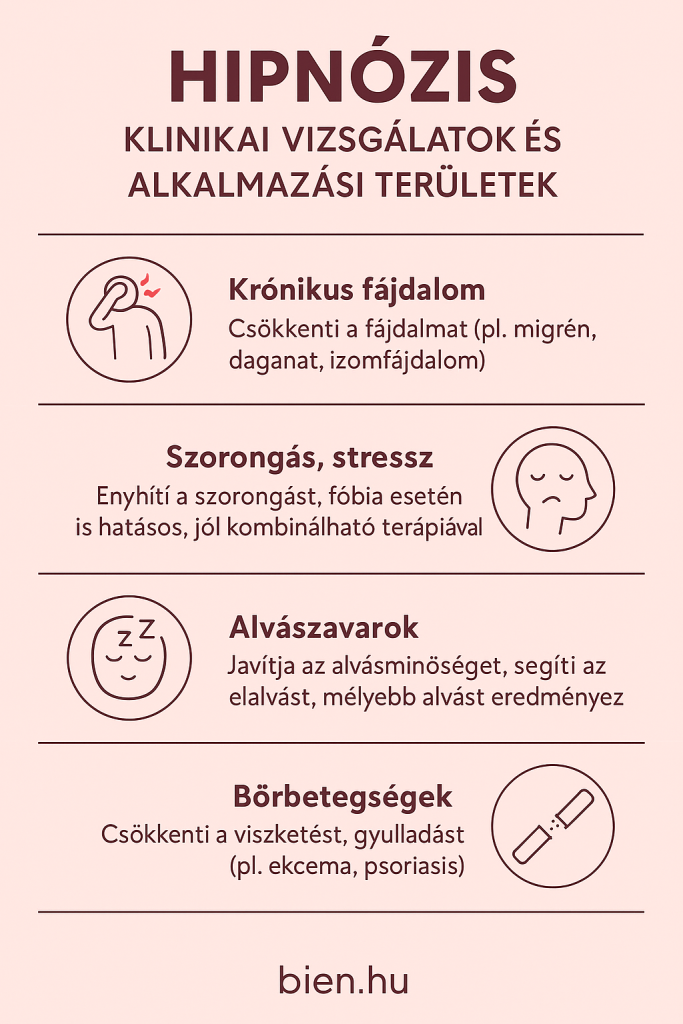
For example, studies in psychology and medicine show that hypnosis can effectively alleviate chronic pain or anxiety. In such cases, hypnosis used alongside traditional medical treatments can improve quality of life.
Hypnosis also improves sleep quality, reducing the time it takes to fall asleep, especially in patients with insomnia.
It has also proven effective in skin conditions: in cases of psoriasis, eczema, and atopic dermatitis, hypnosis relieves itching and reduces inflammatory reactions. In this case, the mind-body connection directly influences the immune response.
Addiction and substance abuse are also successfully treated with hypnosis. It is recognized as an effective method for quitting smoking, overeating, and alcohol problems.
Can anyone learn hypnosis?
In reality, not everyone becomes capable of effectively applying hypnosis, as it requires not only special talent but also serious training and practice. The process of learning hypnosis can be lengthy since it is important to know the techniques precisely and understand psychological contexts.
Experienced therapists who have the necessary experience for applying this method can successfully combine theoretical and practical knowledge during hypnosis treatment. This ensures that hypnosis truly serves the benefit of the patient.