From the very first moment, Valencia caught me off guard. I had expected a pleasant Spanish city. What I found was something far more layered — a place where centuries-old stone archways lead, almost without warning, into a landscape that looks like it belongs on another planet.
Getting wonderfully lost in El Carmen
I set out in the early morning, before the sun had a chance to turn the streets into an oven. The El Carmen neighbourhood is the kind of place that rewards aimless wandering — narrow lanes that twist and double back on themselves, tall colourful buildings leaning in from both sides, laundry strung between balconies, the faint smell of coffee drifting from somewhere unseen.
I started at the Torres de Quart, the old city gate, and let the neighbourhood pull me in. What struck me immediately was the lack of that heavy, closed-off atmosphere you sometimes find in preserved medieval quarters. El Carmen feels alive. The old walls share space with vibrant painted facades and corner bars that have clearly been there forever. I didn't plan a route — I just walked, and it was exactly right.
The narrow streets eventually delivered me, as if by design, to the Mercado Central — and what an arrival that was. Valencia's central market is a breathtaking Art Nouveau structure, and stepping inside means stepping into a full sensory experience: the colours of fresh produce piled high, the sound of vendors and shoppers in full morning flow, the scent of citrus and cured meat hanging in the warm air. I could have spent an hour just watching.
Just around the corner from the market stands La Lonja de la Seda, the old Silk Exchange — a UNESCO World Heritage Site that most people walk past too quickly. I didn't linger long inside, but even from the outside, its Gothic grandeur stops you in your tracks. From there, winding through a few more quiet streets, I reached the Plaza de la Virgen. I sat in the shade of the trees for a while, doing nothing in particular, watching the square breathe. Sometimes that's the best thing you can do in a new city.
Where the past quietly becomes the future
Heading south from the old town, the city begins to shift. The change is gradual — you barely notice it happening — but the medieval gives way to something broader, more open, more grand. Nineteenth-century architecture lines the avenues, and tucked among it are landmarks that anchor the city's identity.
The Plaza de Toros was one of those unexpected stops. Bullfighting holds no appeal for me personally, but the building itself is genuinely impressive — its arched brick facade unmistakably echoing the Roman Colosseum. Right next door sits the Estación del Norte, Valencia's main railway station, which is worth a long look even if you have no train to catch. The exterior is covered in intricate ceramic decoration: oranges and orange blossoms, the symbols of the city, rendered in extraordinary detail. It's the kind of craftsmanship that makes you slow down and actually look.
From there, I followed the Avenida del Reino de Valencia — a wide boulevard with a pedestrian promenade running down its centre, flanked on both sides by towering palm trees. Walking beneath them, with century-old palaces on either side, felt cinematic. Tropical and European at once. Unhurried and elegant.
A different planet, right in the city
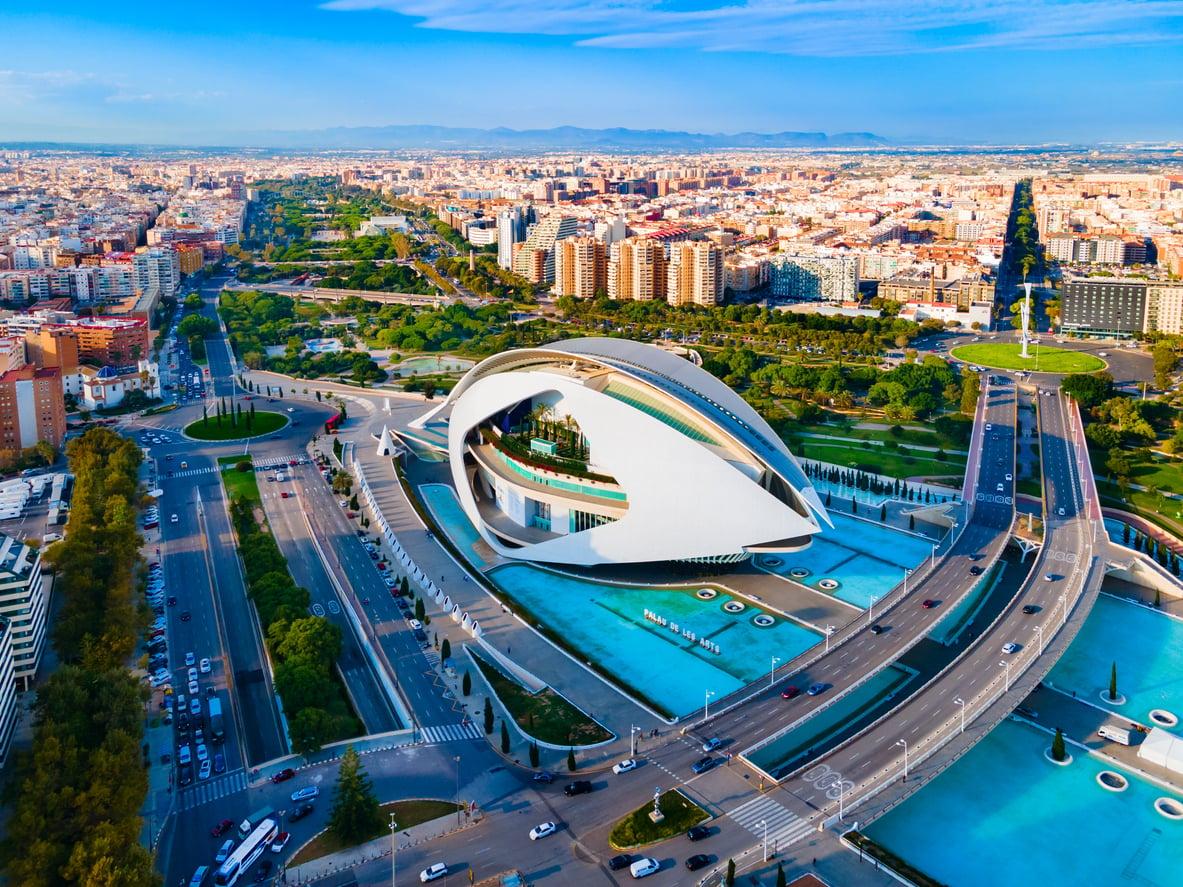
At the end of that walk, almost without transition, I arrived at the Ciudad de las Artes y las Ciencias — the City of Arts and Sciences designed by Santiago Calatrava. Nothing quite prepares you for it.
The complex sits in the old bed of the Turia river, which was diverted after a catastrophic flood decades ago and transformed into a nine-kilometre green park that threads through the entire city. In this lush setting, Calatrava's white concrete structures rise like the bones of some enormous prehistoric creature — skeletal, brilliant, and utterly surreal. The shallow turquoise pools reflecting the buildings made the whole scene feel like a film set, or a vision of a city that hasn't quite been built yet.
I didn't go inside any of the museums — time didn't allow for it — but the architecture alone was worth the walk. If you're curious about what else Valencia's surroundings have to offer beyond the city centre, there's much more waiting just outside the city.
The walk back, and what it all added up to
I made my way back through the Turia park — that long green ribbon running through the heart of Valencia. Joggers, cyclists, families with pushchairs, people reading on benches. The city using its reclaimed river as a living room. It was the perfect way to decompress after a day of almost constant movement.
By the time the palm trees were casting long shadows across the pavement, my feet were tired and my phone was full of photographs. But more than that, I felt like I had actually understood something about Valencia — not from a guidebook or a museum label, but from simply giving myself over to its rhythm.
You don't need a week in Valencia to fall for it. One day, walked well, is more than enough to feel its pull. The city let me go — but I already know I'll be back.