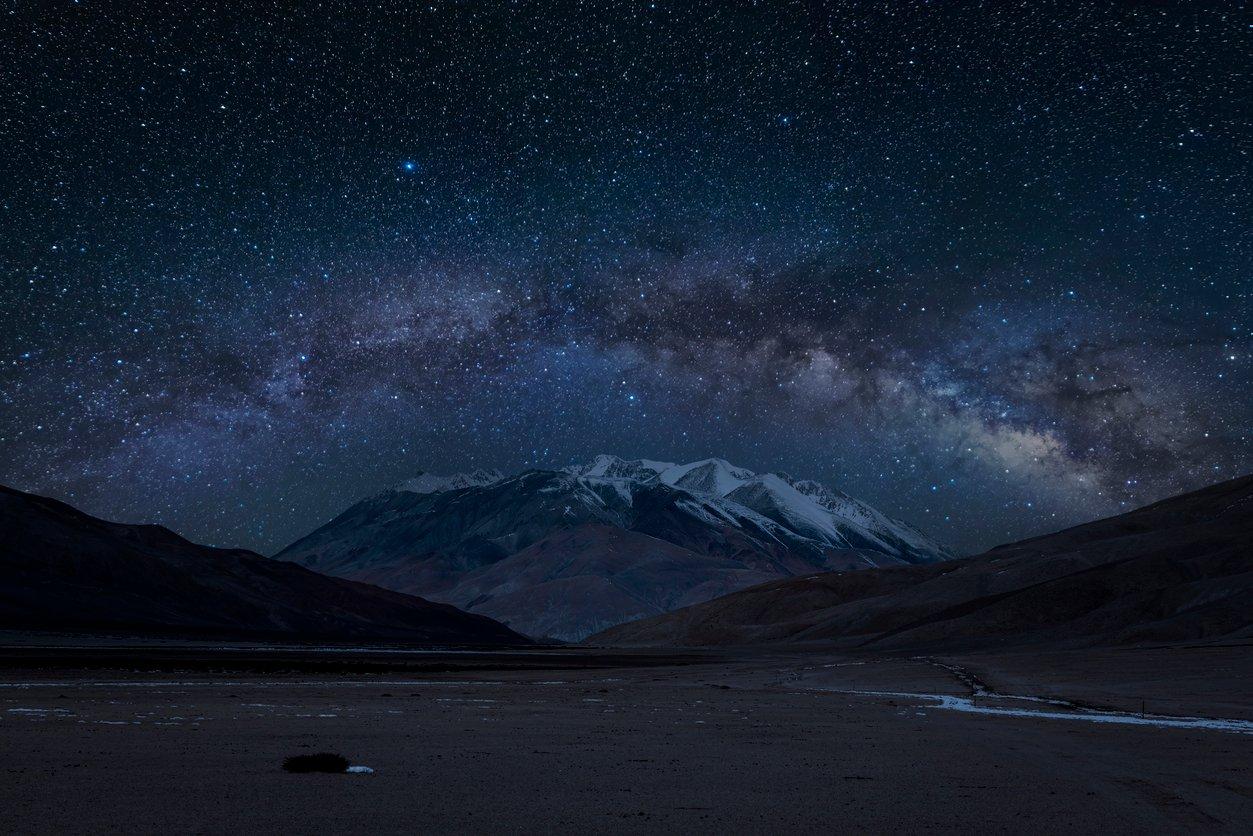
Hanle, a tiny Himalayan village in India’s Ladakh region, is a hidden gem that captivates travelers not only with its lofty altitude but also with its magical night sky. Perched at 5,290 meters (17,356 feet) above sea level, this moon-like, barren landscape reveals a pitch-black sky that feels like the entire universe is spread out at your feet.
According to a BBC report, Hanle earned one of the highest ratings on the darkness scale: a “1” on the Bortle scale, meaning it’s among the darkest, most natural night skies on Earth. About 270 clear nights a year showcase a dazzling dance of stars, while locals ensure artificial light never spoils the view.
Protecting a Natural Wonder
Hanle isn’t just a spot on the map—it’s an experience that’s gently shifting how people see darkness and nature conservation. As a BBC correspondent described:
“It’s like someone slowly unrolling a shadow puppet screen, with stars popping out one by one against the deep blue sky. I watched in awe as the Milky Way stretched above me.”
Residents understand the village’s value, so they switch off lights at sunset and cut power after 11 PM. This commitment is a beautiful example of living in harmony with nature. Many homes have blackout curtains, lamp shades, and warm-toned bulbs to minimize light pollution.
Star Parties and Astro-Tourism: Gateway to the Universe
In recent years, Hanle has become a hotspot for astro-tourism. In 2022, the Hanle Dark Sky Reserve (HDSR) was established, covering over a thousand square kilometers including the village, six nearby communities, a monastery, and ten telescopes. Locally guided stargazing tours and homestays offer visitors close encounters with the starry sky.
The highlight is the September Star Party, which draws serious astronomers and astrophotographers at the end of the short four-month open season. Participants arrive with telephoto lenses, telescopes, and special cameras to capture the Andromeda Galaxy, Saturn’s rings, or distant nebulae. One attendee shared:
“Even when I close my eyes, I only see stars. I feel like lying on the ground and watching them forever.”
Where Past and Future Meet
The Hanle area was once home to Changpa nomads who navigated the dark nights by relying on the North Star. In 1992, the Indian Institute of Astrophysics recognized Hanle’s unique qualities and built one of the world’s highest optical observatories here. Since then, some nomads have settled, forming a close-knit community that blends traditional Buddhist beliefs with modern astro-tourism.
Local traditions honor celestial events like solar and lunar eclipses with special spiritual meaning, and stars even feature in folk songs. Residents celebrate and respect nature’s rhythms while welcoming astronomers from around the world.
Balancing Light and Darkness
Preserving natural values is key for Hanle’s community. The BBC reports that the Indian Institute of Astrophysics has introduced practical measures, like guiding posts to keep vehicles on designated roads. They also plan to spread astro-tourism to other parts of Ladakh to avoid overburdening Hanle.
Farewell to the Stars
On the final morning, before dawn, visitors get one last chance to marvel at Hanle’s unmatched star-filled sky before heading back to Leh. The experience leaves a lasting impression: the natural darkness and cosmic spectacle remind us how fragile and precious our world truly is.
There’s hope that Hanle will keep its balance, sharing the beauty of its starry skies with the world while preserving their pure magic. Hanle is more than a place on Earth—it’s a journey into infinity, where stars don’t just shine but tell stories.