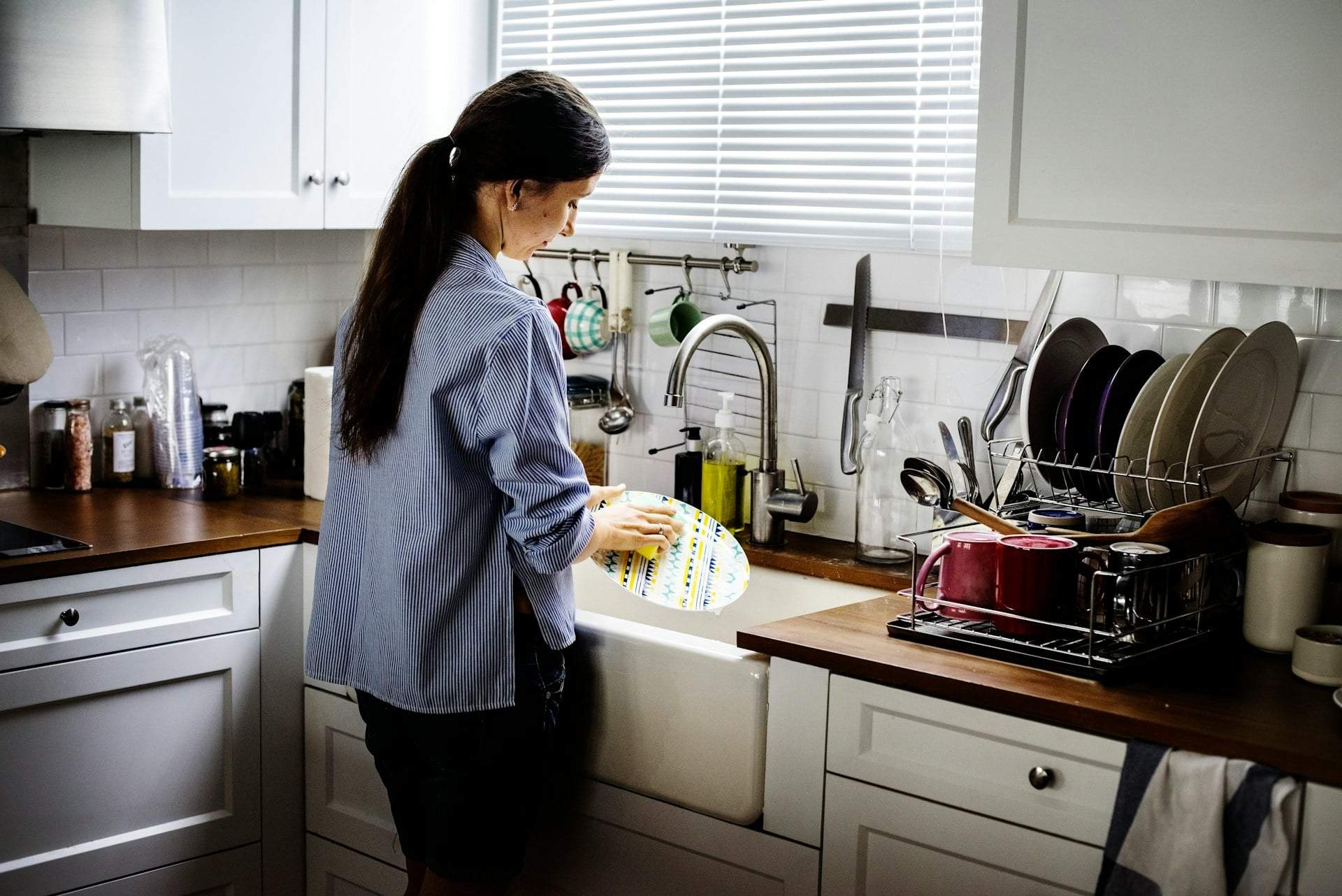
We all know the classic image: a woman sighing as she asks her partner to please put his shoes away. But for a growing number of women, the dynamic is completely reversed. Your partner is the one who notices the towel hanging slightly off-center. He's the one who starts Sunday morning a little tense because the kitchen isn't tidy yet. And you're sitting there, perfectly relaxed, genuinely unsure what the problem is — because everything looks fine to you. If this sounds familiar, you already know what it feels like to sense, day after day, that you're falling short of a standard no one ever said out loud.
The invisible work you actually do
One of the biggest sources of tension in these relationships is that the tidier partner feels like they're the only one who notices anything. The overflowing bin. The nearly-empty laundry detergent. The windows that haven't been cleaned in months. That's a real mental load, and it deserves to be acknowledged.
But here's the thing: you're almost certainly carrying a huge load of your own that simply doesn't register on his radar. You're the one organizing the social plans. You remember the birthdays, the appointments, the deadlines. You handle the logistics he doesn't even realize need handling.
A shared life isn't only made up of physical tidiness — and sometimes that needs to be said out loud.
The invisible labor in a relationship runs in many directions. Recognizing that both of you are contributing — just in different ways — is often the first step toward less resentment and more understanding.
Structure is your friend
Most of the friction in these situations doesn't come from laziness. It comes from the absence of a clear, agreed-upon system. When nobody has spelled out who does what and when, the tidier partner ends up noticing everything and quietly fuming, while the other partner feels constantly criticized for breaking rules they didn't know existed. It's an exhausting loop — and it's one you can actually break.
Sit down together and talk it through honestly. Which areas matter most to him? Where can he genuinely let go? Where are you happy to take ownership, and where is it simply not going to happen naturally? Once those lines are drawn, daily friction drops dramatically — because nobody has to decide in real time whose job it is to straighten the duvet.
The comments that add up
When something gets said every single time a thing is out of place, it wears you down — not because your partner is unkind, but because you can never fully relax at home if you feel like you're constantly being evaluated. After a while, it stops being about the mug on the counter or the jacket on the chair. It becomes about the creeping feeling that you are never quite tidy enough, never quite measuring up to an expectation that was never clearly stated.
When you reach that point, the conversation shouldn't be about the specific sock or dish. It needs to be about the pattern itself — about how this dynamic affects you over time, and what it costs you emotionally to live in a space where you feel perpetually graded.
What's really going on underneath
A strong need for order is rarely just about tidiness. It often runs deeper — a need for safety, control, or the feeling that if the external world is in order, everything inside is okay too.
Many people aren't even conscious of it. They just feel genuinely uncomfortable in chaos, and the only way they know how to express that is by pointing out what's out of place.
When you understand that, it becomes easier to respond with empathy rather than defensiveness. And the same understanding can work in reverse: your more relaxed approach isn't laziness or carelessness — it's simply a different set of priorities. The energy he puts into maintaining order, you're probably channeling into something else entirely. Neither approach is wrong. They're just different.
When does it actually work well?
It works when both of you are willing to move a little toward the middle. That doesn't mean you're setting a 6 a.m. vacuuming alarm, and it doesn't mean he has to stop noticing the things that bother him. It means finding a shared equilibrium you can both live with.
It works when he learns that not every battle needs to be fought — that the kitchen is still fine even if the cutting board isn't in its exact usual spot. And it works when you learn that getting ahead of certain things isn't an admission of guilt, but a small act of care — because you can see it matters to him, and his comfort at home matters to you.
This isn't one-sided compromise. It's two people deciding that shared peace is worth more than both being right. And if you eventually reach the point where you can laugh about the fact that you never know when to change the bedsheets while he has the whole schedule memorized — that's actually a sign you've figured it out. It's no longer a problem. It's just one of those strange, endearing things that makes you you two.