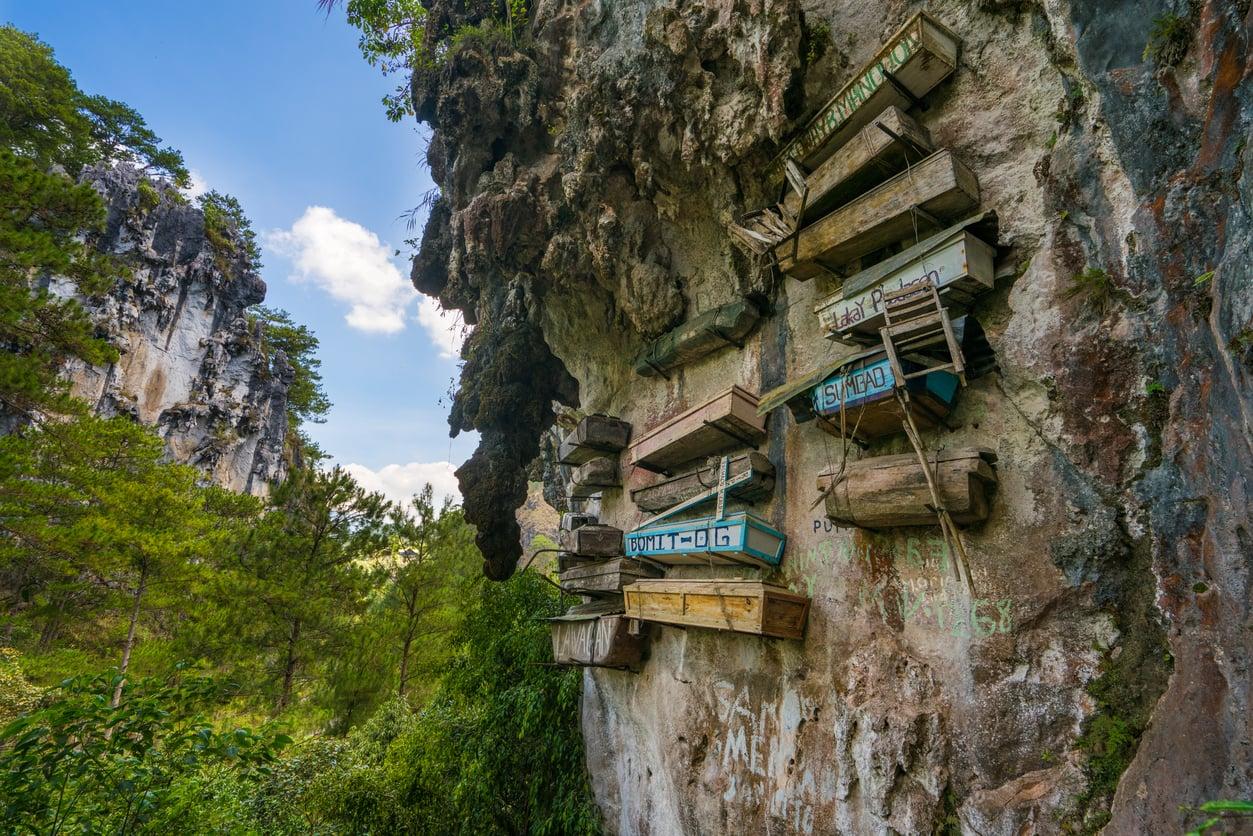
At first glance, it looks like something out of a dream — or a nightmare. Wooden coffins, some centuries old, nailed and wedged into sheer rock faces hundreds of feet above the ground. But for the people of Sagada, a small mountain town in the Philippines, this is not spectacle. It is one of the most deeply meaningful acts a community can perform for its dead.
The mystery of the hanging coffins
The Kankana-ey people of Sagada believe that placing the deceased high on a cliff face brings them closer to the spirit world. The higher the coffin, the nearer the soul to its ancestors — and the better protected it is from malevolent forces that roam the earth below.
There is also a deeply practical dimension to this tradition. Sagada sits in rugged highland terrain where flat, fertile land is scarce. There simply isn't enough soil for conventional burials. Hanging coffins on the rock face was not only a spiritual choice — it was also a remarkably pragmatic solution to the geography of the land.
How the ceremony unfolds
When a community elder dies, their body is placed in a hand-carved wooden coffin, often made by the deceased themselves before death — a final act of preparation and acceptance. Family members and community elders then carry the coffin up the cliff, accompanied by ritual chants and prayers that guide the soul on its journey.
Every object used during the ceremony carries meaning. Symbols etched into the wood, items placed inside the coffin, the specific songs sung — all of these reflect the life the person lived and the bonds they leave behind. The ritual is not just a farewell. It is a reaffirmation of who the community is and where it comes from.
If you're drawn to the ways different cultures make sense of loss and mortality, you might also find it fascinating to explore other extraordinary funeral customs from around the world — each one a window into a different understanding of life and death.
Keeping tradition alive in a changing world
Modern life has reached even the mountains of the Philippines, but the people of Sagada have chosen to hold on. Elders pass the knowledge to younger generations with care and intention. The hanging coffins are not relics of a forgotten past — they are living symbols of collective identity, of a community that refuses to let its roots be washed away by time.
Young people in Sagada grow up understanding that these cliff-face coffins are not morbid curiosities. They are their grandparents, their great-grandparents, their ancestors — watching over the valley from above.
Why Sagada is worth knowing about
A journey to Sagada offers more than breathtaking mountain scenery. It offers a rare encounter with a culture that has found its own answer to one of the most universal human questions: what do we do with those we lose?
The hanging coffins of Sagada remind us that grief, memory, and the need to feel connected to those who came before us are not uniquely modern struggles. They are as old as humanity itself — and sometimes, the most profound responses to loss are the ones that quite literally lift the dead toward the sky.