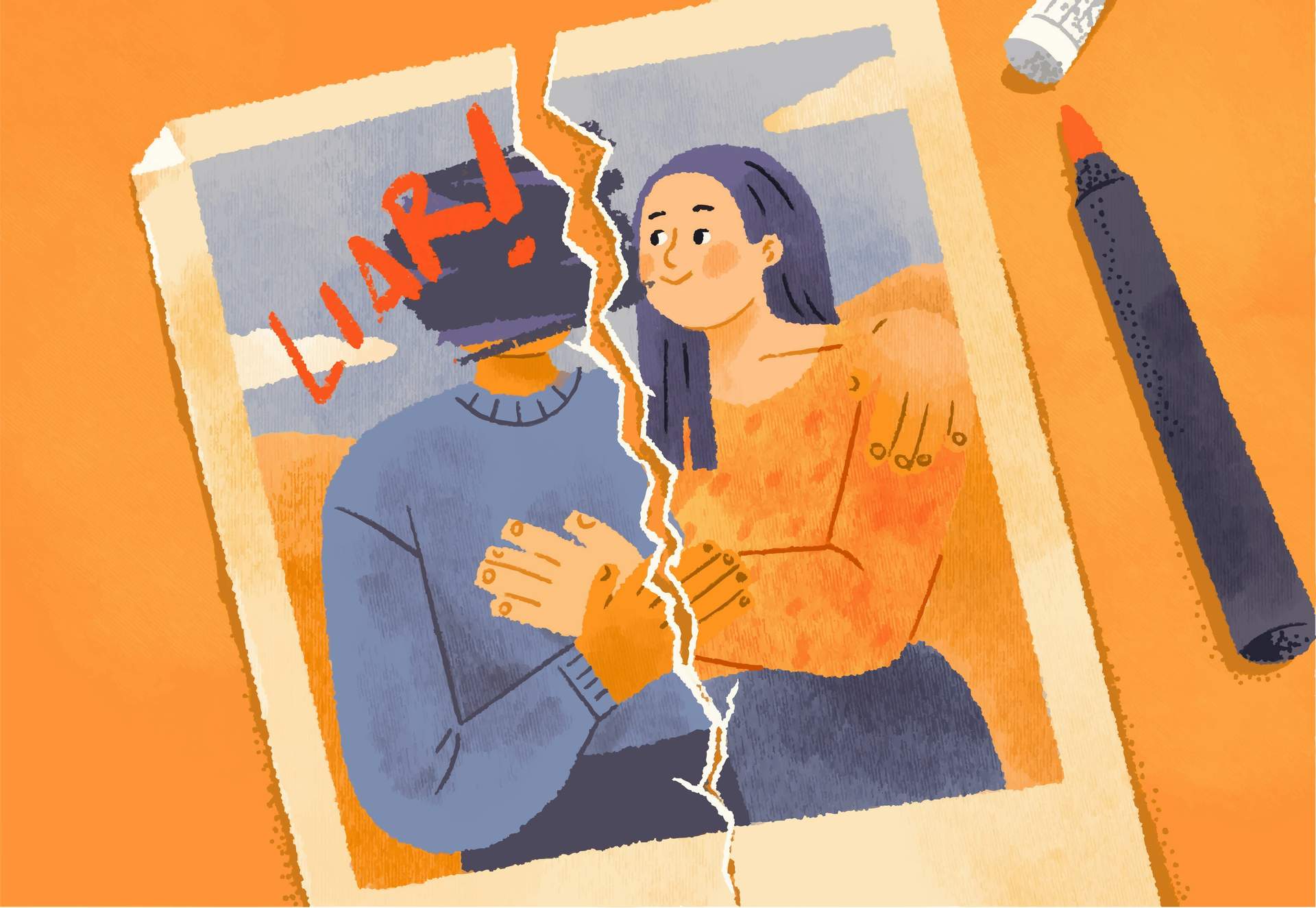
There are rules nobody needs to write down. Your best friend's husband or partner is simply off-limits. He might be charming, funny, even attractive — and it wouldn't make you a bad person to notice. But he's still off-limits. That's exactly what makes it so deeply unsettling when he's the one who starts testing that line. Three women shared their stories of the moment their best friend's partner went too far.
"He started by asking me not to mention the message to her"
"My best friend's husband and I had known each other for about ten years. Our relationship was always completely normal — we'd joke around sometimes, but nothing ever felt off between us," says Palma, 42.
"One evening I got a message from him. It opened with a request: please don't tell his wife about this, because he 'didn't want to upset her.' Then he said he hoped I wouldn't be angry. And then he told me he found me very attractive — and that if my best friend weren't his wife, he'd definitely make a move."
"I wrote back that I was pretty sure he already knew exactly why I was going to show this to her. I took a screenshot and sent it over. I expected an explosion."
Instead, about ten minutes later, she called. All she said was: "I can't believe it. Thank you for sending this."
It turned out her husband had been acting strangely for months. She'd been convincing herself she was imagining it. That screenshot made everything click into place. They eventually divorced. And Palma says she still feels that one message didn't just speed up the end of a bad marriage — it saved a friendship.
"At first I thought he was just being friendly"
"My best friend's husband was always very warm with me. Whenever I came over, he'd make me coffee, ask how I was doing, and regularly tell me something looked great on me," recalls Sara, 39.
"Then one time my friend couldn't make it to a group get-together, and I ended up spending the evening with her husband and a couple of mutual friends. On the way home, he messaged me: 'Too bad it wasn't just the two of us.'"
"I replied that it sounded pretty strange. He immediately backpedaled — just a joke, he said. But a few weeks later he messaged again. This time he asked whether I thought his wife would notice if we grabbed a glass of wine together, just the two of us."
That's when I stopped treating it as banter. I told him that if I ever received a message like that again, the first thing I'd do was show my friend.
He never messaged again. And I never told her. But ever since, I can't quite look her in the eye the same way — and I carry this guilt, as if I were somehow the one who did something wrong.
"He told me I was misreading the whole situation"
"My friend's husband had always been pretty direct, but after a while he started reaching out more often. At first it was all innocent enough — a funny video, a restaurant recommendation, asking what I thought of a film," says Zita, 33.
"Then the messages shifted into something I couldn't interpret as friendly anymore. One evening he asked whether I was happy in my relationship. When I asked why he wanted to know, he wrote: 'Just curious — because I think you deserve so much more.'"
"I told him to stop.
The next day he called and told me I'd misunderstood everything. He wasn't making a move — he was just talking to me. I was overreacting, he said.
So I asked him one question: 'If there's really nothing to this, why haven't you told your wife what you've been writing to me?'
A long silence followed.
He didn't need to answer. And since then, I've had one rule: if someone who is my best friend's husband tries to share a secret with me, I won't be the one keeping it."
Why does this feel so complicated?
What makes all three of these stories so hard isn't the behavior itself — it's the position it puts you in. You didn't ask for it. You didn't encourage it. And yet suddenly you're the one deciding whether to blow up your friend's life or carry a secret that slowly corrodes everything.
The guilt these women describe — even Sára, who never responded and immediately set a boundary — is telling. When someone else crosses a line, they create a mess that others are left to clean up. And the cruelest part is that the person responsible often walks away feeling like nothing happened at all.
Each of these women handled it differently. One sent the screenshot. One drew a firm line and stayed silent. One asked the one question that couldn't be answered. None of it was easy. All of it was right.
Is it always worth telling your friend?
There's no universal answer. But the women in these stories point to something important: the secret itself becomes a weight. Keeping it doesn't protect the friendship — it quietly hollows it out. The distance you start to feel isn't guilt about something you did. It's the cost of protecting someone who wasn't asked to be protected.
If you've ever been in a situation like this, you already know: the discomfort doesn't go away on its own. And the longer it sits, the heavier it gets.
What do you do if your best friend's partner crosses the line?
Every situation is different, but a few things tend to hold true: name it clearly in the moment, don't minimize it to yourself, and if it goes beyond a single comment — document it. A screenshot, a saved message. Not to create drama, but because you deserve to be believed if it ever comes to that.
You are not responsible for protecting his image. You are not responsible for managing his wife's feelings on his behalf. You didn't create this situation. And you're allowed to decide you won't carry it alone.
Did these women do the right thing?
Palma sent the screenshot and says it saved her friendship. Sara set a boundary, stayed silent, and still carries the weight of it. Zita asked one question and never needed to say another word. Three different choices — and all of them came from the same instinct: this is not mine to absorb.
What if she doesn't believe you?
It happens. Sometimes the person you're trying to protect becomes defensive. Sometimes the loyalty runs the wrong way. That's a painful outcome — but it doesn't mean you were wrong to speak. It means you found out something important about the relationship that was worth knowing.
What if the behavior was ambiguous?
Zita's story captures this perfectly. The messages could each be explained away individually — but together, they formed a pattern. Trust the pattern. If something feels consistently off, it probably is. You don't need a single undeniable moment to take it seriously.
Is staying silent ever the right choice?
Based on what these women shared, staying silent after one clear boundary was set — as Sara did — can stop the behavior. But it rarely stops the discomfort. Whether to tell your friend is a separate decision from whether to confront him. You can do one without the other. What matters most is that you don't end up alone with something that was never yours to carry.