Opinion: Borka Schuster
If someone had told me a year ago that I'd be buying my daughter a face wash and moisturizer at the age of seven, I probably would have raised an eyebrow.
Not because I'm against skincare. Quite the opposite. It's just that seven still feels so young to have your own line of cosmetics sitting on the bathroom shelf.
Then, a few months ago, I noticed the first tiny blackheads next to my daughter's nose. And what mattered even more: she noticed them too.
At first she just studied herself in the mirror. Then she asked what those little dark dots were. We talked about it, and I told her it was completely normal. Our skin is always changing — it produces oil, pores can get clogged, and all of that is simply part of life.
I didn't blow it out of proportion, but I didn't wave it away either. Because even though she knew it was natural, I could tell it bothered her.
And meanwhile, summer was coming
More sunscreen, more sweating, more time in the sandbox, more bike rides and full days spent outdoors. I feel it myself this time of year — my skin needs more cleansing than it does in winter — and I decided that maybe it was time to introduce a very simple, very basic routine.
So my daughter got her own face wash. Not a ten-step Korean routine. No acids. No serums. No "anti-aging" products. Just a gentle, fragrance-free, additive-free face wash from the more affordable shelf at the drugstore. And a light moisturizer to go with it. That's all.
When I mentioned this to someone, the first thing I heard was: isn't that too early? I don't think so. Because I don't see this as beauty care. A certain level of skincare, to me, is simply a matter of hygiene.
Just like I taught her to brush her teeth when she was little. Just like I taught her to wash her hands. And just like the moment eventually came when she had to learn how to properly clean her private areas, I felt it was time to pass on this knowledge too.
Because these are all part of how our bodies work and how we take care of them. And while the beauty industry likes to act as if skincare is only about appearances, the most fundamental part of it is really just protecting your health. Cleansing, moisturizing, sun protection. Nothing more.
The routine we built together
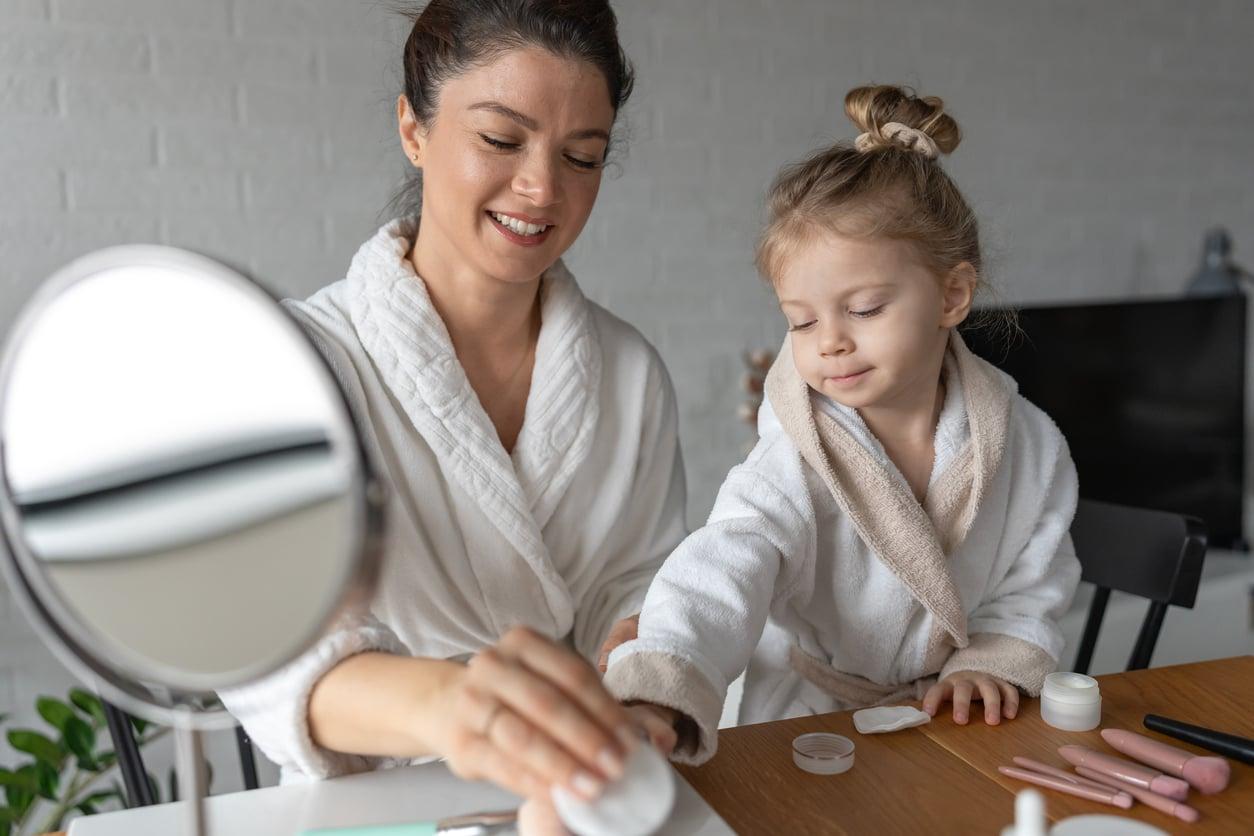
But the whole thing had an unexpected side effect. Ever since, we wash our faces together in the evenings. She uses her own little face wash, I use my own products. Then we put on our creams side by side, and we talk.
She asks why I use more products than she does. Why I have a separate eye cream. Why I sometimes reach for a wrinkle serum. And these moments open the door to conversations that might otherwise be harder to have.
We talk about how cleansing and sun protection are matters of health. But whether someone wants to do something about their wrinkles is a personal choice. That there's no right or wrong answer, that it's natural for skin to change over time, and that this is completely okay.
We've talked about how everyone's face is different. About freckles, moles, pimples, wrinkles. About how our bodies are always changing, and how there's no need to panic over every new line or spot.
Honestly, I feel these conversations matter far more than the face cream itself. Because I don't want to teach her how to look perfect. I want to teach her how to have a healthy relationship with her own body. How to care for it, how to pay attention to it.
And how to accept that her body, her skin and her face will change over the years. From the outside, this may look like nothing more than a face wash and a small tub of moisturizer. But to me, it means so much more than that.
It's another step in a long process that I hope leads her to become a woman who takes care of her body — not to please others, but because she genuinely loves it.
Is seven too young to start skincare?
Not for a simple, basic routine. As this mom describes it, gentle cleansing, moisturizing and sun protection are really about hygiene and health, not about beauty or looking perfect.
What products are appropriate for a young child's skin?
Keep it minimal: a gentle, fragrance-free face wash and a light moisturizer. Skip acids, serums and "anti-aging" products, which aren't meant for a child's skin.
How do you talk to a child about skin changes?
Be honest without dramatizing. Explain that skin naturally produces oil, that pores can clog, and that freckles, moles and pimples are all normal parts of a changing body.
Why does a shared skincare routine matter?
Washing your faces together turns a small daily habit into connection. It creates natural moments to talk about the body, self-acceptance and caring for yourself for the right reasons.