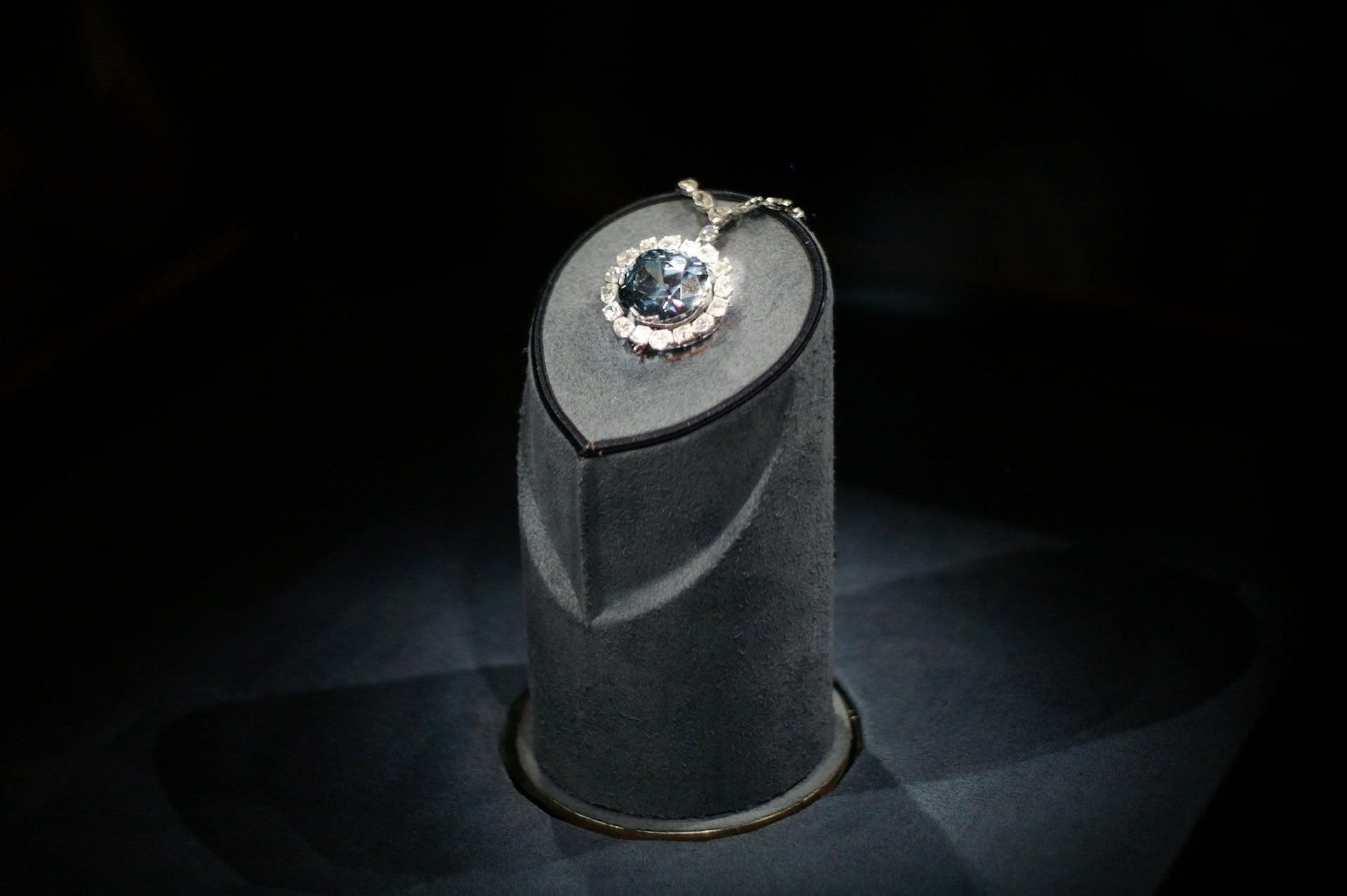
Few objects in history carry as much dark fascination as a single gemstone. The Hope Diamond — a deep, steel-blue jewel of breathtaking beauty — has been linked to madness, financial ruin, violent death, and personal catastrophe for nearly four centuries. Coincidence? Perhaps. But the stories are hard to ignore.
Where it all began
The diamond's story starts in 17th-century India, in the legendary mines of Golconda. In its original form, it was part of a much larger stone — roughly 112 carats — and, according to legend, it once adorned the statue of a Hindu deity. A brahmin priest is said to have guarded it with deep reverence.
That reverence didn't last. When European traders set their eyes on it, the stone was taken from its homeland and began a long, turbulent journey westward. It eventually found its way into the hands of King Louis XIV of France, who had it recut and wore it proudly as the "Blue Diamond of the Crown." Even then, the first shadows of misfortune were beginning to gather.
The curse takes hold
The legend of the Hope Diamond's curse is built on a striking pattern: nearly everyone who owned or wore it seemed to meet with disaster. The most famous name attached to the stone is Marie Antoinette, who lost her head during the French Revolution. Historians debate whether she ever actually possessed the diamond, but the story took on a life of its own — and it hasn't faded since.
After the chaos of the Revolution, the diamond disappeared for a time, then resurfaced in England. It eventually passed to Lord Francis Hope, the man whose name it now carries. His ownership was marked by mounting debts, a collapsing marriage, and one personal setback after another. He was eventually forced to sell it just to survive.
Other owners fared no better. Collectors and socialites who acquired the stone over the following decades reported financial ruin, broken relationships, and untimely deaths — enough to keep the legend burning bright long after the diamond had changed hands again.
Where the Hope Diamond rests today
Today, the Hope Diamond sits behind glass at the Smithsonian Institution in Washington, D.C., where it draws millions of visitors every year. It is one of the most viewed museum objects in the world — and one of the most talked about.
Scientists and historians have worked hard to debunk the curse, pointing out that many of the tragic stories attached to the stone are exaggerated, misattributed, or simply invented. And yet, the myth endures. There is something about this particular diamond that refuses to be explained away.
Is it pure coincidence — a chain of unrelated misfortunes woven together by human imagination? Or is there something about this stone that genuinely unsettles the lives it touches?
What the Hope Diamond really teaches us
Strip away the legends, and the Hope Diamond still tells a profound story. It reminds us that no object, however rare or beautiful, can guarantee happiness. Across the centuries, its owners pursued it as though possessing it would bring them power, prestige, or joy — and time and again, it brought the opposite.
We tend to look for meaning in misfortune, to reach for curses and fate when the real answers lie in our own choices. The Hope Diamond is a mirror, not a hex. What it reflects back at us is the depth of human longing — and the dangers of believing that something outside ourselves holds the key to our lives.
With all its secrets intact, the Hope Diamond remains one of history's most compelling objects. A stunning gem, a dark legend, and an enduring reminder of how powerfully the human imagination can shape the stories we tell.