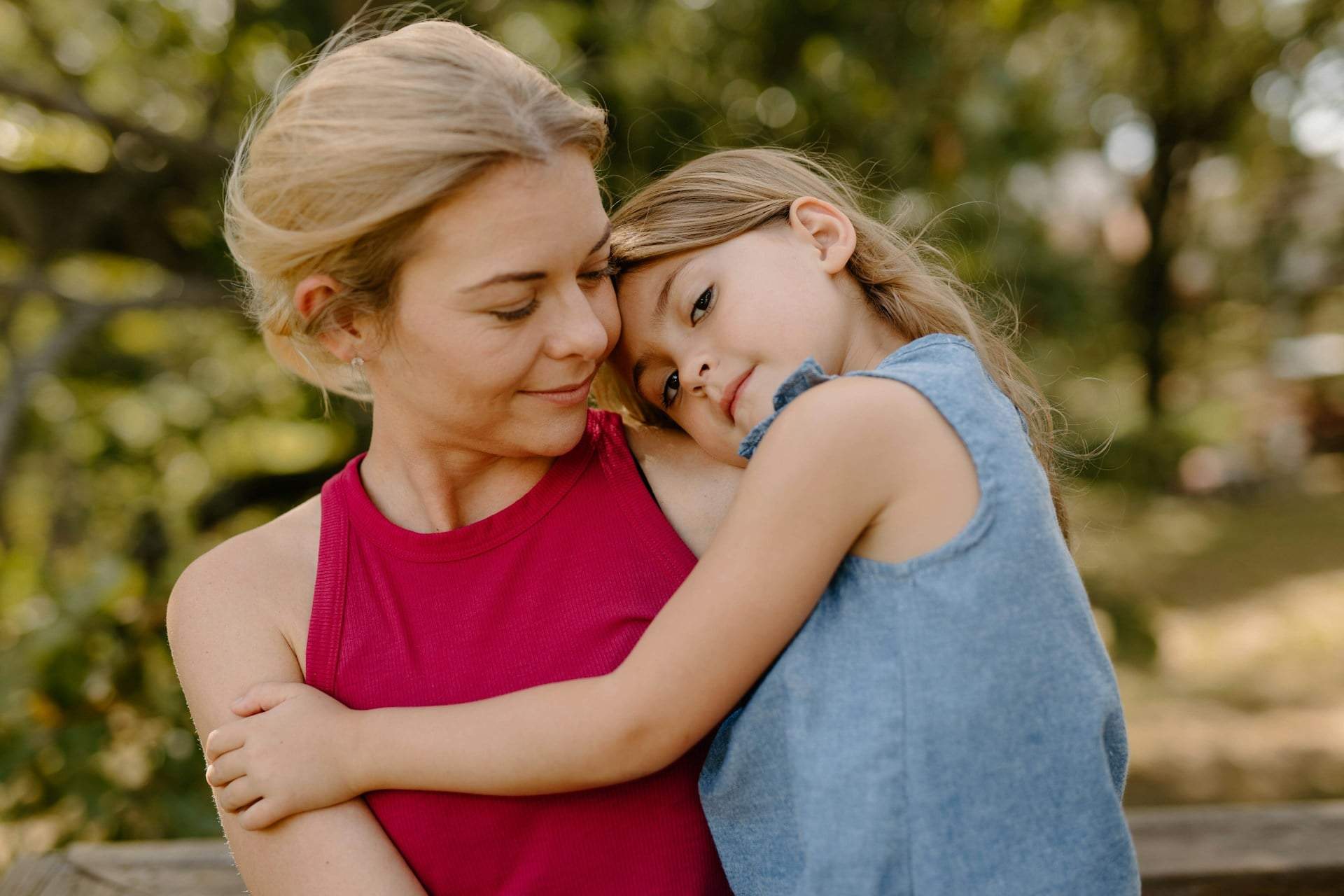
My daughter loves to compliment me in the mornings. It's become a little ritual — she watches me get ready, and something warm and playful passes between us. I do the same for her: I tell her she's incredibly smart, funny, and sensitive. I tell her I love the color of her eyes, that the blue dress suits her perfectly, that I'm completely obsessed with her wild, untameable hair.
She gives it right back. Sometimes she says she likes my lipstick shade. Other times, that I look pretty in my skirt. These exchanges always felt safe — a small, warm space where beauty was simply joy, not a measuring stick.
Then one morning, something different landed in the air
"You look beautiful, Mom! So slim!"
The words just hung there. Same voice, same child, same loving moment — and yet I felt something shift. A tiny crack in the walls of that safe little space we'd built together.
I didn't know where she'd heard it. I didn't know exactly what she meant by it. What I did know was this: I didn't want "slim" to become a condition of "beautiful" in her mind.
I am naturally slim — always have been. She'll likely inherit a similar build. But that's precisely why it matters so much to me that what she sees and hears doesn't quietly narrow her definition of beauty down to a single shape.
I want her to love her body. The way I try to love mine. Not because it's slim. Not because it meets some unspoken standard. But because it's hers.
I genuinely believe that every body is beautiful. And that beauty is not a ranking. There are no "better" or "worse" bodies — only different ones, each carrying a different life.
So I didn't let that comment go with a simple "thank you."
Instead, we started talking
What does a beautiful body even mean? What does a healthy body look like? What does a strong body feel like? Why do we love our bodies? These questions weren't scripted — but as we spoke them out loud, it became clear just how many layers they carry.
And something else became clear too: the word "slim" is not neutral. It comes from somewhere. It means something. My seven-year-old already has associations in her head that the world planted there without my noticing — that a healthy body is a slim body, that fitness equals thinness, that there's a straight line between body size and beauty.
That frightened me. But it also made me curious. Because I know she didn't learn those things at home. They seeped in — through images, fairy tales, overheard conversations, advertisements, the background noise that surrounds every child today whether we like it or not.
And yet, I was also glad the comment came out. Because now I had something to respond to. Something we could actually talk about. It didn't stay silent. It didn't float in the air as an unquestioned truth.
This won't be the last conversation
I know there are many more ahead of us. There will be strange remarks, confused questions, maybe moments of real uncertainty. And there will be plenty of chances to say it again and again: a body cannot be measured by a single standard, and being worthy of love has nothing to do with size.
If I want to protect her from the pressure that social media, advertising, and social expectations will eventually pile onto her as a young woman, these conversations are not optional. They're essential.
And honestly? I don't want to avoid them. I want to be the voice she hears first — before the world gets too loud.