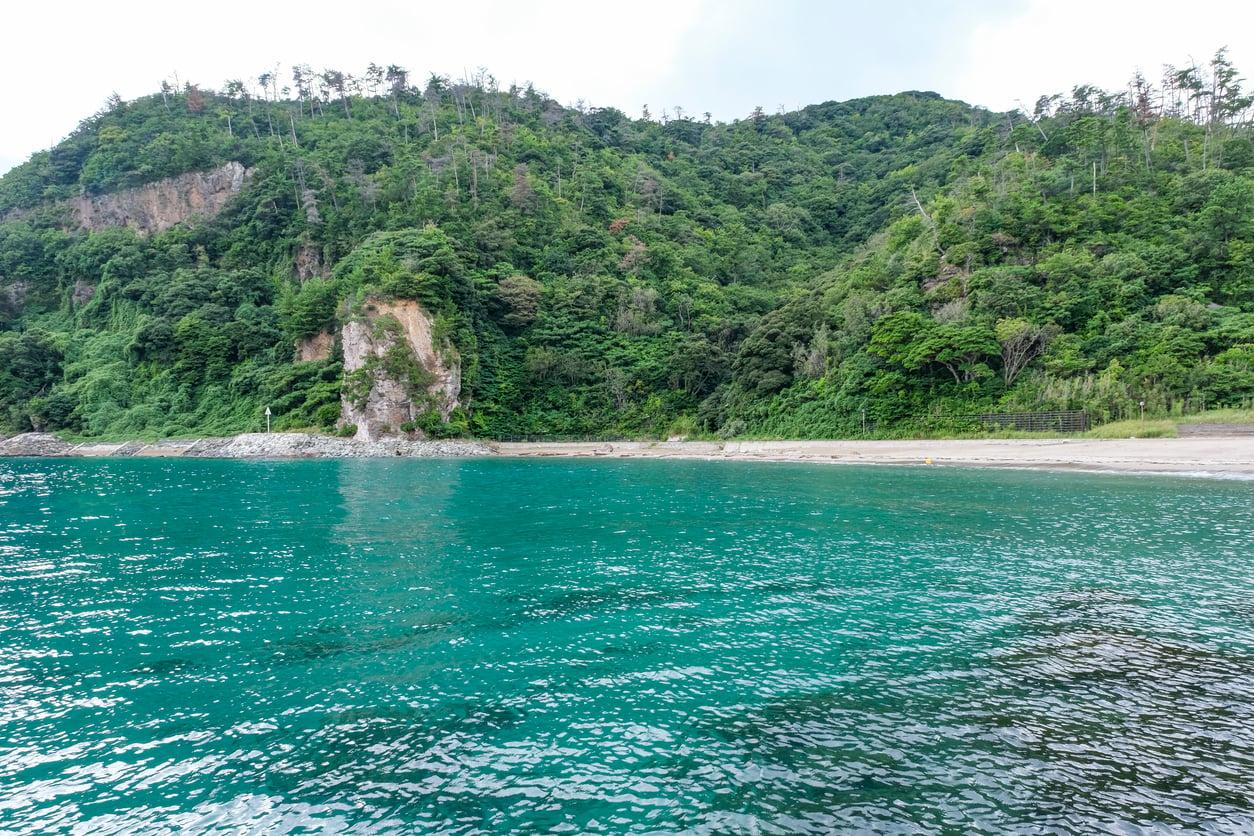
There is a tiny island off the coast of Fukuoka, Japan, where an ancient rule remains firmly in place: no women are permitted to set foot on its shores. Not as tourists, not as researchers, not under any circumstances. In the 21st century, that fact alone is enough to stop you in your tracks — and the story behind it is even more fascinating.
A thousand years of sacred history
Okinoshima is no ordinary island. With over a thousand years of documented history, it once served as a vital waypoint along ancient maritime trade routes connecting Japan to the Korean peninsula and China. Shrines, relics, and ritual objects discovered here reveal that religious ceremonies have been performed on this island for centuries — offerings made to the gods in exchange for safe passage across the seas.
The island is home to the Okitsu-miya shrine, part of the Munakata Grand Shrine complex, and its sacred objects are so numerous and so well-preserved that archaeologists have compared the site to an open-air museum of early Japanese civilization.
Why are women not allowed?
This is the question most people ask first — and it doesn't have a simple answer. The ban is rooted in the island's Shinto spiritual tradition, which holds that Okinoshima must be kept in a state of absolute ritual purity.
According to those who uphold the tradition, the presence of women would disturb the island's sacred balance and compromise the sanctity of its rituals.
While this reasoning feels deeply at odds with modern values, it's important to understand it within the context of ancient Shinto belief — where purity rules governed not just gender, but diet, behavior, and even the words spoken on sacred ground. The restriction on women is one part of a much broader and deeply held spiritual framework.
The rituals that still take place today
Even men are not freely welcome. Once a year, on May 27th, a small number of male visitors are permitted to come ashore — but the conditions are strict. Before entering, each visitor must undergo a purification ritual, immersing themselves in the sea to cleanse both body and spirit.
Once inside, participants offer prayers and present ritual offerings — including precious stones and sacred objects — as acts of gratitude to the gods. The ceremony draws a direct line between the living and the divine, between the human world and the forces of nature that surround the island.
There is one more rule that applies to every visitor without exception: nothing may be taken from the island. Not a pebble, not a leaf, not a grain of sand. Everything that exists on Okinoshima is considered sacred and must remain there.
A UNESCO World Heritage site unlike any other
In 2017, Okinoshima was inscribed as a UNESCO World Heritage Site — a recognition of its extraordinary cultural, historical, and spiritual significance. The designation brought the island international attention, but it also raised uncomfortable questions.
How does a site that excludes half the world's population earn a place among humanity's shared heritage? It's a tension that UNESCO itself acknowledged, and one that continues to generate debate among historians, anthropologists, and human rights advocates alike.
Yet for many, Okinoshima represents something rare: a place where ancient tradition has been preserved almost entirely intact, untouched by tourism or modernization. That preservation comes at a cost — but it also offers a window into a world that has otherwise largely disappeared.
Could the rules ever change?
Some voices in Japan and beyond have called for the ban on women to be reconsidered. They argue that cultural heritage must evolve alongside society, and that exclusionary practices — however ancient — deserve scrutiny in a world that values equality.
Others insist that the rules are inseparable from the island's identity. Change the ritual, they say, and you change the meaning of the place itself. It is a genuine and unresolved tension — one that puts Okinoshima at the center of a much larger conversation about Japan's relationship with its own traditions and how ancient customs survive contact with the modern world.
For now, the island remains as it has always been: silent, sacred, and almost entirely closed to the outside world. And perhaps that mystery is precisely what makes it so impossible to forget.