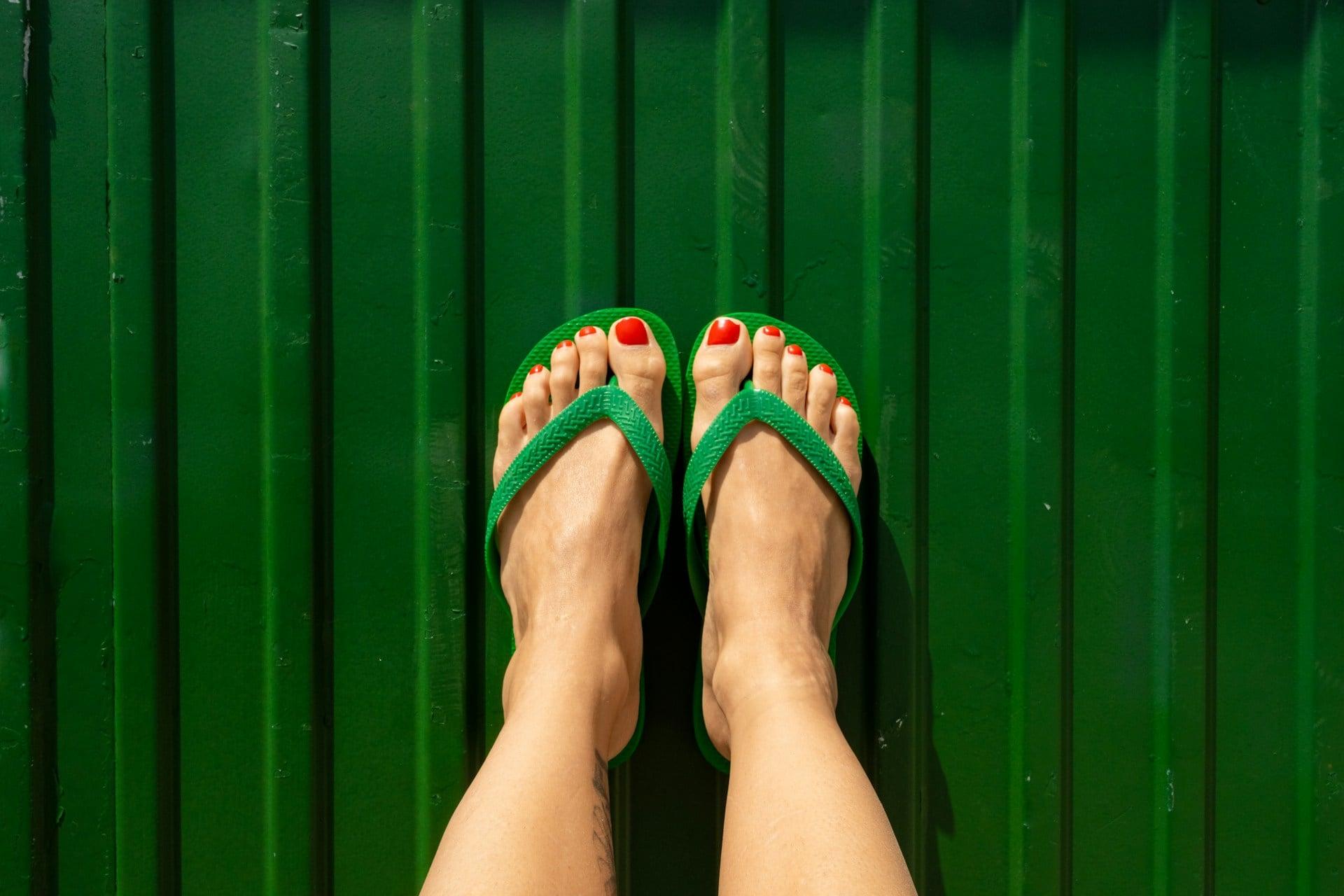
They're easy to slip on, they feel comfortable, and in summer they seem like the obvious pick when you're just running to the store or picking up the kids. But here's the catch: what your feet handle effortlessly on soft beach sand, your body processes very differently on hard pavement. And over time, it shows up in the way you walk — in your ankles, and even in the soles of your feet.
Why pavement is nothing like sand
Sand and grass give way with every step. That softness forces the muscles in your feet and ankles to make tiny corrective movements, which actually strengthens them. Pavement, on the other hand, is completely unforgiving. It gives nothing back — every impact travels straight up into your ankles, knees and hips.
Now add a completely flat, unsupportive flip-flop to the mix, and your foot has literally nothing helping it land stable and straight on the ground.
What actually happens to your feet
Most rubber flip-flops and the classic thin-strapped sandals offer no arch support, no heel cup, and no side-to-side stability. To keep the flip-flop on your foot at all, you instinctively curl your toes a little and put extra load on the inner arch of your foot.
Repeat that movement pattern day after day, and it can lead to overpronation — your ankle and foot rolling inward with every step, instead of rolling cleanly from heel to toe.
Your plantar fascia takes a hit too
Running along the bottom of your foot is a thick band of fibrous tissue called the plantar fascia. Its job is to hold up your arch and absorb the shock of every step. When you pound the pavement in unsupportive flip-flops day in and day out, that tissue stays constantly overstretched.
The result can be a sharp, stabbing discomfort near the heel — especially in the morning, on those first steps out of bed. It's called plantar fasciitis, and while it isn't dangerous on its own, it's stubborn, uncomfortable, and can drag on for a long time if you don't change your habits.
Your ankle doesn't suddenly ache at the end of summer because of one bad step. It aches because you repeated the same tiny mistake with every single step for weeks.
Which flip-flops are the riskiest
Not all of them are equally guilty. The biggest strain comes from completely flat rubber flip-flops with zero arch support and those thin thong-style sandals that wedge between your toes — especially when you pair them with a full day of city walking, shopping, or lots of standing around.
In those shoes, your foot is basically left to fend for itself, while the hardness of the pavement sends back everything the sole can't absorb.
When you're better off putting on real shoes
If you're just stepping into the garden for a few minutes or walking from the beach to the snack bar, flip-flops are absolutely fine. The trouble starts when they become your only footwear for an entire summer weekend, a day of sightseeing, or a long shopping trip.
For those occasions, it's worth switching to a sandal with at least some arch support — even a thin-soled one — or a lightweight pair of sneakers, so your foot isn't forced to grip and cling with every step.
What to look for if you still choose flip-flops
- Look for a model with at least a minimal, noticeable arch support along the inner edge of the sole.
- Choose styles with a back strap over the thong versions that sit between your toes — they hold your heel far more securely.
- If you notice yourself involuntarily curling your toes as you walk, that's a clear sign the flip-flop isn't giving you enough support.
- For longer days out in the city, pack a spare pair of shoes and save the flip-flops for the shorter stretches.
Your feet tell the same story every day about how you've treated them. They just don't reply right away — the answer comes weeks or months later, in the form of a nagging heel pain or a strangely tired ankle.
Are flip-flops always bad for your feet?
No. For short walks — from the garden to the driveway, or the beach to the snack bar — they're perfectly fine. The problem is wearing them all day on hard pavement, when they become your only footwear for hours.
Why does pavement make flip-flops worse than sand?
Sand gives way with each step and lets your foot muscles adjust naturally. Pavement is completely rigid, so every impact travels straight up into your ankles, knees and hips with nothing to absorb it.
What is plantar fasciitis and how is it linked to flip-flops?
Plantar fasciitis is an overstretching of the fibrous tissue under your foot that can cause sharp heel pain, especially on your first steps in the morning. Walking on hard surfaces in unsupportive flip-flops keeps that tissue constantly strained.
How can I tell my flip-flops aren't supportive enough?
If you catch yourself curling your toes to keep them on, that's a clear sign. Look instead for a noticeable arch support and a back strap that holds your heel in place.