Every year around now, the same thing happens on my balcony. The light goes at eight, then half past seven, and the plants stop being something I sit with and become something I glance at through glass. It took me an embarrassingly long time to work out that the problem wasn't the temperature. It was that after dark the balcony simply stopped existing as a place. A blanket fixes cold. Only light fixes that.
There's a lovely idea going round at the moment about garden lighting as a kind of small enchantment — strings of light through shrubs, glow in unexpected corners. I'd argue it matters even more on a two-metre balcony than in a proper garden, because a small space that reads as a room in the dark effectively adds a room to your flat for the price of a few bulbs.
The rule that changes everything: light low, never down
The single most common mistake is one bright light mounted high, shining downwards. It flattens everything, throws hard shadows, and turns the window into a mirror so you can't see out. What you want instead is several small, low, warm sources at or below eye level, each doing a small job.
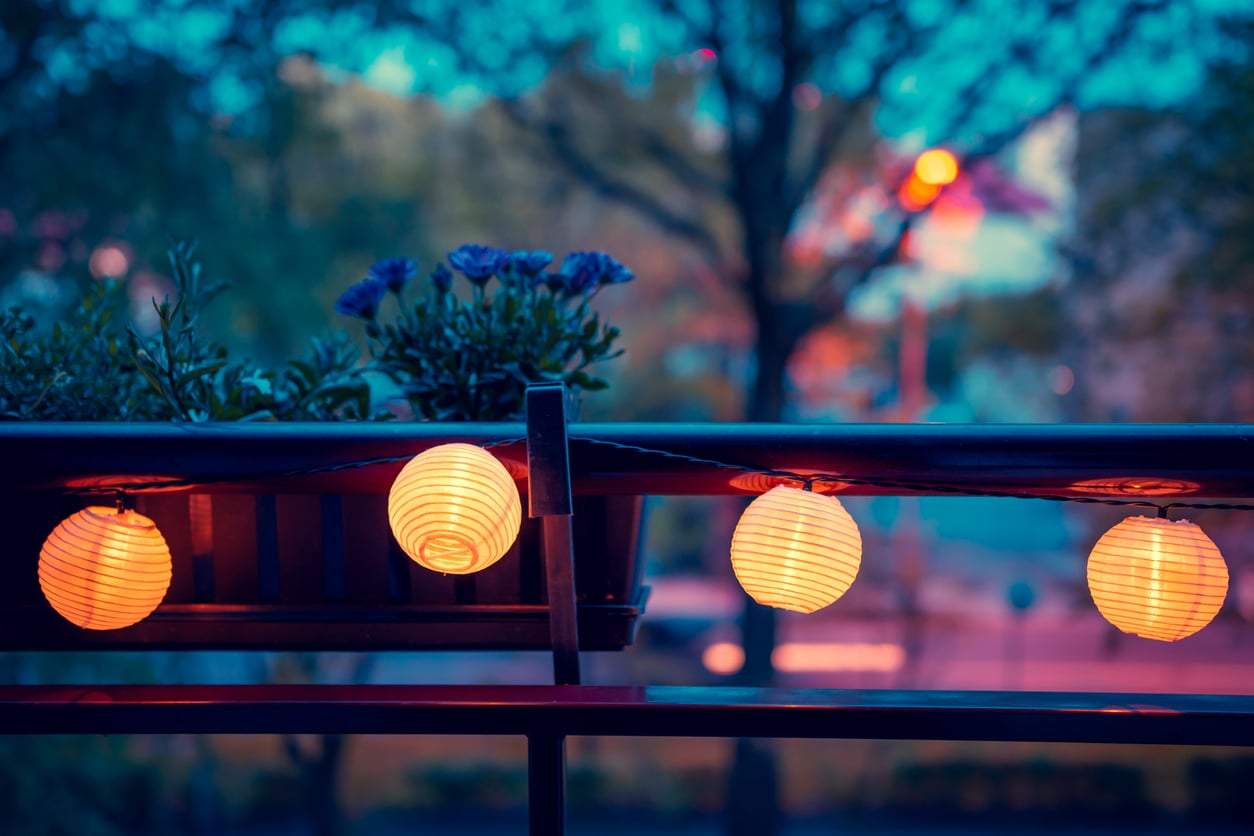
Think in three layers. Something at floor level — a lantern on the decking, a battery candle in a jar, a small uplight pushed into a pot so it grazes up through the leaves of a fern or an olive. Something at table height, which is where you actually look while talking. And something soft and high only if it's diffused: a string of warm bulbs threaded along the railing or looped through a trellis, never a spotlight.
Colour temperature is worth being fussy about. Warm white, the kind that looks slightly amber, makes skin and plants and brick all look better. Cool white makes a balcony look like a fire exit.
Uplighting plants is the trick that costs almost nothing
Take any single potted plant with structure — a grass, a bamboo, a small tree, a leggy pelargonium — and put one small light in the soil at its base, angled upwards. The effect is disproportionate. You get a big shadow thrown onto the wall behind, the leaves turn translucent, and suddenly you have depth instead of a dark rectangle.
Two or three of these, spread around, beat any amount of overhead light. Solar versions work but be honest about your aspect: on a north-facing balcony in October they'll manage about twenty minutes. Rechargeable USB lanterns or a low-voltage set you bring in over winter are more reliable. Whatever you buy, check it's rated for outdoor use and keep any mains connection under proper cover.
Give the light something to sit in
Lighting works best when it's lighting something. Late August into September is the moment to tidy the balcony so the light has structure to catch — deadhead what's finished, cut back anything sprawling and brown, and move the plants with the best silhouettes towards where you'll sit.
If you're buying anything this autumn, buy for shape rather than flowers: a small evergreen, an ornamental grass that catches light in its seed heads, ivy up a trellis. Add a mirror or a pale-painted board on the wall behind your lights and the whole space doubles. Then the soft things — an outdoor cushion, a heavy blanket in a lidded box, a tray. The lighting makes it a room; the textiles make it a room you'll actually use on a Wednesday.
How do I stop the lights annoying my neighbours?
Aim everything inwards and downwards or into planting, never outwards across a shared courtyard or up towards someone else's windows. Low-level, warm, shielded lights that graze surfaces rather than beam into space are both prettier and far less intrusive, and a timer that turns everything off at a sensible hour saves you from being the flat that glows all night.
How late in the year is it worth sitting outside?
Later than you'd think, if the space is set up for it. Wind is the real limit rather than temperature — a sheltered corner with a screen or a tall plant on the windward side stays comfortable well into the colder months with a blanket, a warm drink and something in a lantern to look at. If you only manage twenty minutes with a coffee before work, that still counts, and those short doses of outdoor light in the morning tend to be the ones you miss most in midwinter.