There is a particular kind of defeat that happens at six in the evening, when you are holding a hot pan in one hand and opening three cupboards in a row looking for the lid that fits it. Nothing is missing. Everything is simply somewhere else. That is the moment most people decide they need more storage, when what they actually need is a different arrangement of the storage they already have.
I have reorganised my kitchen cabinets roughly four times in eight years, and the version that finally held wasn't the prettiest one. It was the one built around how we genuinely cook on a Tuesday, rather than how I imagined I might cook if I were a calmer person with more free time.
Start by emptying one cabinet, not all of them
The standard advice is to take everything out and start fresh. In a real household with people walking through it, that produces a kitchen floor covered in saucepans and a project you abandon at nine at night. Do one cabinet at a time, and start with the one that annoys you most — usually the deep corner unit or the cupboard above the kettle.
Empty it completely, wipe the shelf, and then sort what came out into three piles on the counter: things you have used in the last month, things you use a few times a year, and things you are keeping out of guilt. The guilt pile is where the wedding-present ramekins live, along with the second colander and the lidless containers. Be honest about it. You are not obliged to store an object simply because it was once expensive.
Map your zones before you put anything back
Think about where you physically stand when you do each job. There is a washing-up zone, a cooking zone at the hob, a prep zone wherever your biggest clear surface is, and a making-tea-and-breakfast zone. Every item should live in the zone where it is first used, not where it looks tidiest.
That means pans and cooking oils and the utensil pot go within arm's reach of the hob. Chopping boards, knives and mixing bowls go by the prep surface. Mugs, tea, coffee and the sugar tin cluster near the kettle — and if that cupboard is currently full of baking tins you use at Christmas, those tins are taking up the most valuable real estate in the room. Move them to the top shelf of the least convenient cupboard and give the prime spot to something you reach for daily.
The other rule worth following: store things at the height that matches their weight and frequency. Heavy, often-used items between hip and shoulder. Light and rarely used up high. Bulky and occasional down low.
Fix the four problems every kitchen has
Lids are the first. Stop stacking them with the pans. Stand them upright in a single shallow box or a tray at the front of the pan cupboard, in rough size order, and you will stop excavating.
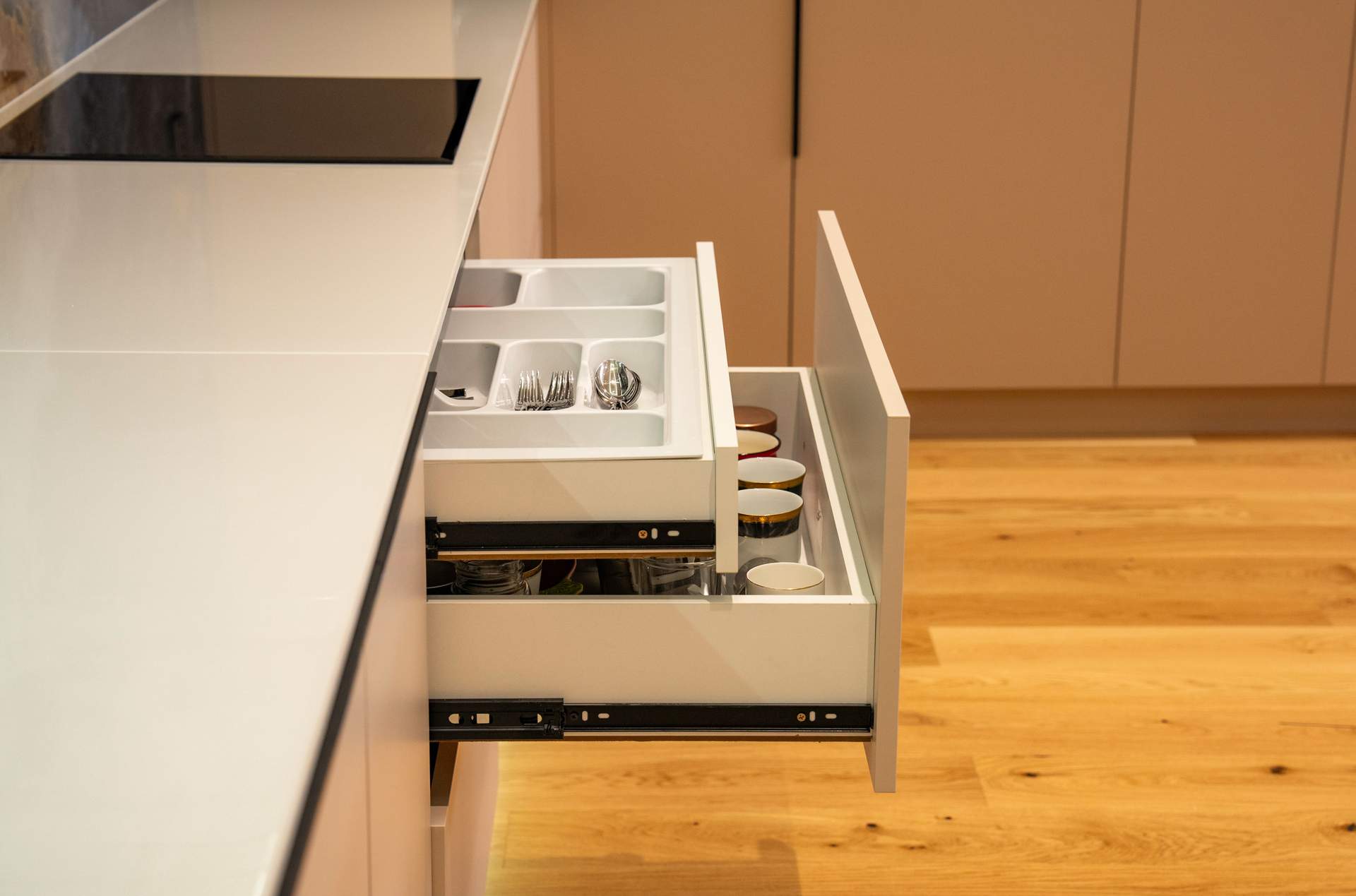
Deep cupboards are the second. Anything beyond the front row becomes invisible. Treat the back half as long-term storage for things you genuinely use once a season, or put the back items into a shallow crate you can pull out whole like a drawer. A cheap rectangular container does the same job as an expensive pull-out.
Food containers are the third. Keep only the ones with lids present and accounted for, nest the bases, and keep lids separate and upright. If a base has gone lidless, it is now a drawer organiser or it is gone.
The fourth is the dumping cupboard — the one that collects vitamin bottles, birthday candles, carrier bags and batteries. Give it a purpose instead of pretending it will become tidy. One box for medicines and plasters, one for cables and candles, one for bags. Labelled or not, boxed chaos is navigable chaos.
Why does my kitchen get messy again so quickly?
Usually because the system requires more steps than the moment allows. If putting the olive oil away means opening a cupboard, moving two jars and sliding something sideways, the oil will live on the counter forever. Look at whatever keeps migrating back out and give it a home that takes one hand and one second — an open shelf, a tray by the hob, a wide drawer. Tidiness survives when it is the path of least resistance, not when it depends on willpower at the end of a long day.
Do I need to buy organisers and baskets?
Not until after you have reorganised and lived with it for a fortnight. Buying containers first is the most common way to spend money and still have the same problem, because you end up storing clutter more attractively. Once the zones are settled, you will know exactly which two or three gaps need solving — a lid rack here, a tiered shelf for spices there — and you can measure properly instead of guessing. Shoeboxes and cut-down cereal packets are perfectly good prototypes in the meantime.