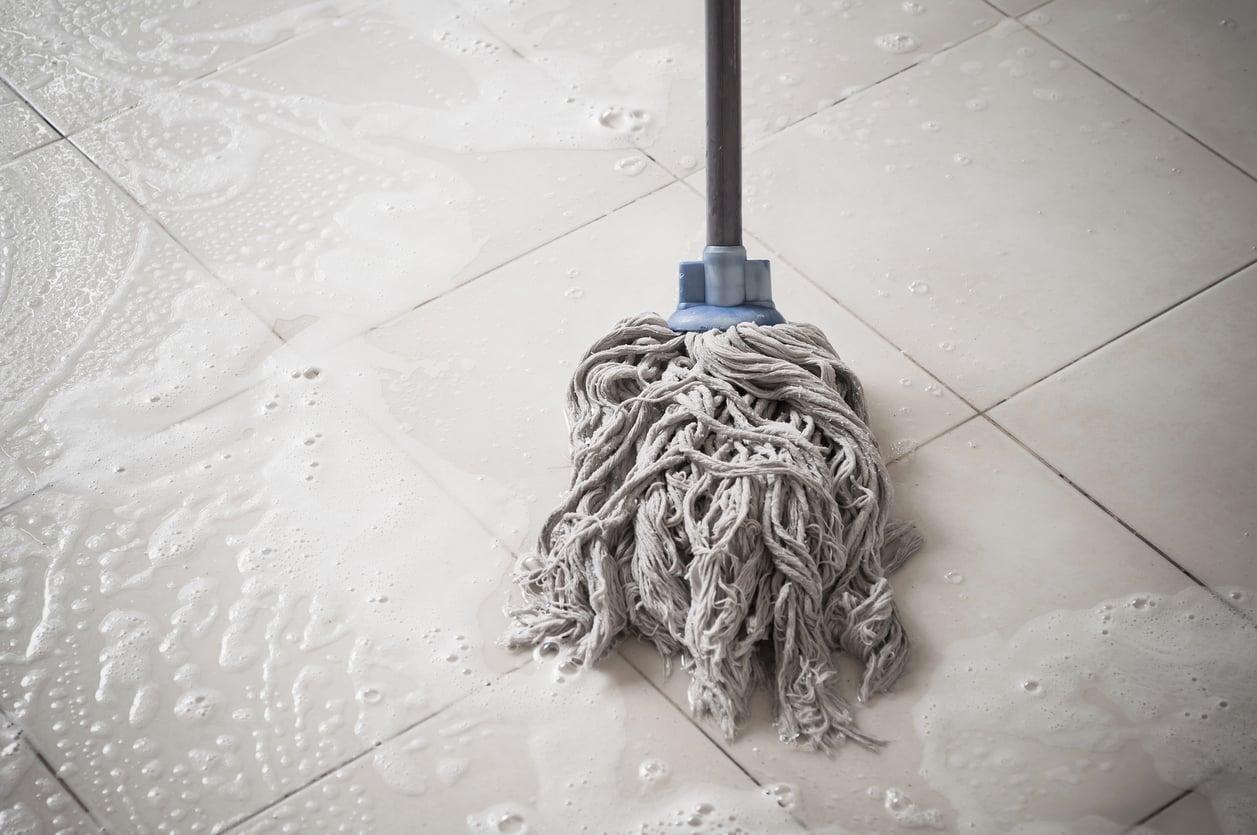
You've just mopped the kitchen, swept up every crumb, and yet there it is: that tacky feeling under your socks, like you stepped in floor glue. You're not clumsy, and there's nothing wrong with your mop.
The truth is that sticky floors almost always come down to a handful of tiny, persistent mistakes — the kind we pass down from one generation to the next without ever questioning them. Here are the six most common culprits, and how to finally break the cycle.
More cleaner doesn't mean a cleaner floor
The most widespread myth is that the more dish soap or floor cleaner you pour into the bucket, the cleaner your floor will be. In reality, the opposite is true.
Excess product doesn't evaporate — it settles on the surface as a thin, sticky film that then attracts even more dust and footprints. If anything, use a little less than the amount recommended on the label, and when in doubt, start small. You can always add more; you can't easily un-pour it.
The mop water you keep reusing
Plenty of people start the whole home with a single bucket of water and only change it at the very end. The problem is that as time goes on, the water fills up with grime, grease and old cleaning-product residue — and the mop smears all of that right back onto the floor with every dip.
This is one of the biggest reasons the surface ends up stickier at the finish than it was at the start. Swap the water the moment it turns cloudy, especially before moving into a new room.
It's not about how much cleaner you use. It's about how much clean water you use.
The rinse step almost everyone skips
Most of us mop once and then let the floor dry, but removing the leftover cleaning product matters just as much as the washing itself. If you only go over the floor once with soapy water, an invisible layer stays behind and grips onto dust and footprints.
A second pass with clean, lukewarm water and a well-wrung mop makes a surprising difference to the final result. If you want to avoid streaks and stickiness for good, it's worth reading up on what you should never add to your mop water.
The mop head you rarely deep-clean
Your mop head or cloth becomes saturated over time with cleaning-product residue, grease and soapy buildup — even if you rinse it after every use. That layer then transfers straight back onto the floor at every mop stroke, no matter how clean the water in your bucket is.
Every so often, give the mop head a separate soak in hot water, maybe with a splash of vinegar, so it can shed the grime it's been quietly collecting. A clean floor starts with a genuinely clean mop.
The floor type you never account for
It makes a real difference whether you're dealing with laminate flooring, tile or linoleum. What works perfectly on a stone floor can be exactly what causes that tacky feeling on laminate — either because it doesn't dry properly, or because the surface behaves differently.
It's worth matching the amount and type of cleaner to your own flooring, rather than following the same routine out of habit simply because it's what your mum or grandma always did.
Less water, faster drying
A well-wrung mop matters not only because it puts less water on the floor, but because quick drying stops cleaning residue from sitting on the surface long enough to grab onto dust.
If your floor stays wet for minutes after mopping, that's a near-certain sign you used too much water or too much product — and the stickiness will show up sooner or later.
Why is my floor still sticky after mopping?
Usually it comes down to too much cleaning product, dirty mop water, or skipping a rinse. Any of these leaves a thin film on the surface that traps dust and footprints.
Should I rinse the floor with clean water after mopping?
Yes. A second pass with clean, lukewarm water and a well-wrung mop removes the leftover cleaning residue that causes stickiness, and noticeably improves the final result.
How often should I deep-clean my mop head?
Every so often, soak it separately in hot water — with a splash of vinegar if you like — to remove the grease and soapy buildup that a quick rinse can't shift.
Does the type of flooring change how I should mop?
It does. A method that's perfect for stone or tile can leave laminate feeling tacky, so adjust the amount and type of cleaner to suit your specific floor.
Why does a well-wrung mop matter so much?
It puts less water on the floor and helps it dry faster, which stops cleaning residue from sitting on the surface and binding to dust.